Showing posts with label psychology. Show all posts

Tuesday, January 18, 2022

The five dimensions of personality

Time for a business psychology post...

Last month I was asked to present my ‘top tips’ on supporting change, based on my experience managing a network of healthcare professionals. My first tip was to understand that in a complex system, the real complexity is the people working in that system.

One of the things I realised when doing my MSc in Business Psychology is that psychology can be a reductive science. (Particularly if you go down the route of explaining every action by analysing brain activity.) So it’s no surprise to find that generally all human personality is often reduced to five dimensions – usually called the ‘Big Five’. Some people advocate even fewer, and some split some of the five up into other streams.

But for the purposes of understanding people in a work environment, the ‘Big Five’ are all you need. There is also a handy acronym to remember them by – OCEAN.
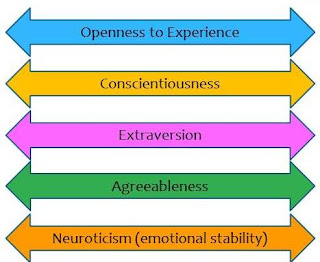

The five letters of OCEAN represent

  • Openness to Experience
  • Conscientiousness
  • Extraversion
  • Agreeableness
  • Neuroticism (emotionality)

All five of these personality dimensions are continua. We all display greater or lesser aspects of them. The assumption is that as most people grow up, they stabilise in places on the various continua. If they were cautious children they will be cautious adults and display less openness to new experiences or curiosity about the world. Personally I think it’s a mistake to assume that people will always act a certain way. Some people seem to compartmentalise their lives and exhibit very different approaches in work to outside work. They may be very risk averse in work and compensate for that with risky behaviour in their hobbies and pursuits. 

There is no real right or wrong place to be on the continua, but people who operate on the extremes are more difficult to function with in work.

For example, people who are extremely open to new ideas and curious about trying new things can be great at innovation and fixing systemic problems. However, they can get distracted. They often leave projects half-completed. They can go down research rabbit holes. And they are often susceptible to sales pitches and latch on to magic bullets that will solve all their problems.

At the other end of that continua are the joyless jobsworths who were told how to do a job a certain way on day one of their employment and will retire 45 years later doing the same job the same way. It’s really easy to spot those people. Just ask them why they do something the way they do it. If the answer is “We’ve always done it this way”, then they have low levels of openness.

Conscientiousness is often seen as a good trait in a co-worker or employee, because, obviously, nobody wants to be working with reckless people who don’t care about anything.  However, overly conscientious people can become obsessed with procedure, to the point where they are paralysed into inaction for fear of doing something wrong.

Extraversion and introversion aren’t exactly a continua. Introverts can do what extraverts do; it just takes more mental effort. Extraverts don’t get worn out by people as quickly. You can easily spot extraverts and introverts because the extraverts want everyone to go out to the pub after work, while the introverts just want to quietly slope off home. (There's a topical point to be made here about party-keen extraverts being more likely to have an office wine fridge filled by sloping off to the off-licence with a suitcase to buy booze.)

Extraverts are energised by people, so are often regarded as enthusiastic and keen, geeing up the team and pulling everyone forward on a project. Those are all good things. But in my experience, because extraverts are energised by people, they tend to do work in meetings and task groups but not between meetings. They can be very productive in the group environment, often banging out plans and strategies in a short time.

In contrast, introverts find it hard to make decisions in meetings. They often want more time to consider things and weigh up options, backed up by research. Typically, they will go back to their desk and start actioning the list of things that need doing, which they will bring to the next meeting. A good team will have both types of people in and a good manager will recognise that they need to feed the extraverts with group time and protect the happiness of the introverts by giving them space.

Agreeableness is an interesting continuum, and one that I feel has capacity for people to be at different points on the continuum depending on context. Generally, agreeable people are much nicer to work with. They make the team environment more pleasant. However, it’s possible to be too nice and this can impact on productivity directly, with too much social chatter and concern about non-work conversations, and indirectly if people are seeking a consensus before making progress. Sometimes movement happens when a person with a lower level of agreeability decides to take initiative even though a few noses will be put out of joint. 

Another way that highly agreeable people can cause problems is through enabling toxic behaviour. I have some experience of people with high levels of agreeability whose main role in a team seems to be smoothing feathers ruffled by more disagreeable members of the team. This prevents confrontation and means that the more disagreeable person is never held to account for their actions that are upsetting people, so they continue to function in the same way. In the long term that poisons relationships.

Finally, neuroticism is about how deeply a person feels emotions, not necessarily how much they express them. Some people display flashes of anger, then very quickly regain an emotional equilibrium and move on. Other people don’t express emotion and internalise a large amount of stress and resentment. There is some debate whether neuroticism should really be in the Big Five, because it seems more liable to fluctuation than the other dimensions.

It’s also the only dimension where lower levels are considered more beneficial in a work environment. Generally, people who are overly emotional and get very stressed over every issue they face are not easy to work with. However, I would be wary of people who never express emotion. They may seem like unflappable bastions of resilience, but it might just be a case that they don’t express emotion because they don’t feel things like empathy and compassion.

There are loads of different activities that can help reveal people’s tendencies on the Big Five continua. If you have ever sat through an ice-breaker that will designate you as an animal, or a cartoon character, or assign you a colour, you have probably been profiled in some way. It’s then up to the managers to observe the outcomes of those activities and tailor their approach to fit. Although, the ability to do that successfully, is, of course, dependent on where the managers themselve are situated on the various continua!

Thursday, August 12, 2021

Football nerdery data representation

When I was studying Business Psychology I briefly got sidetracked onto a tangent about the psychology of collecting (blogged here). I think that offers a good insight into why some people obsessively go to football matches - often called 'groundhopping'. It's a collecting impulse. 

People who go to a lot of football matches in a lot of different places tend to keep some sort of record of it, for example, in an Excel spreadsheet (I do this), or using an app created to help them, like the Futbology App (which I use regularly).

As an aside, Futbology was originally called Groundhopper, but apparently that had less of a cachet to it than the developers had hoped, so they changed the name.

The problem is if you have all this data, what do you do with it? Futbology has a neat feature where you can review your personal stats, looking at all the different grounds you have been to, and a list of all the clubs you have seen. But that only goes so far, and like a spreadsheet, it's not that exciting to look at.

I used the list of teams I've seen to update my Top 10 Table of teams that I have seen. I previously did this up to the end of the 2017 season and a lot has changed since then. This is my current top 10, up to the end of the 2020-21 season.


The big new entrant since the last time I posted a table is Barry Town, who weren't even in the top ten back in 2017. They are now second in the table, usurping Cardiff City, although I have seen the Bluebirds 18 times since I published my previous top ten. The New Saints are also new entries and are going to climb the table as well, given that I've already seen them twice since June!

Tables are all well and good, but I also have another project on the go. A long time ago, before we were married, even, Cathy gave me a 'Book of Days' as a present. 


These are handy books that you are meant to write birthdays and memorable events in on given dates. I wrote a few in, but then it sat and languished in a drawer for two decades. Then a few years back I decided to go through my lists of football matches and fill in the book with all the games on the date I saw them. The result is something like this.


If you look closely, you will see that a number of those games on the pages shown are international matches because the end of March tends to be an 'International Break' every year. Most of the time I just write the score but sometimes I add in other details, as can be seen on 30 March, where I noted that TNS v Barry was a Welsh Cup semi-final played at Newtown.

It is fun flicking through the pages, remembering games. It's also fun when I get to 'tick off' a day like I did when I saw TNS in a Europa Conference League game at the end of July.


The days either side of that game are still blank. The challenge is on for 2022!

I've also taken the data from the Book of Days and put it into grid format, blacking out all the days that I have seen a match. The result looks a bit like an elongated QR code.


The gaps in the summer months are really noticeable in this data display. That one lone square in the middle of June is the game I went to in Salt Lake City when we were on our road trip around Utah. (Here is a very old blog post about that game!)

Meanwhile, back to the Excel Spreadsheet and one way I arrange my data is games by month. The white gaps in the middle of the above grid is also noticeable in table form, as a large numerical disparity.


I have been to almost 10 times as many games in August as I have in June. Although I do watch a lot of games in June if there is a tournament happening. It's just that tends to be on TV! November and February are the months I'm less likely to go to a live game during the season. February is a short month (although I did manage a five Saturday February just before the world was pandemified back in 2020!). I don't know what November's excuse is.

One of the fun aspects of collecting is arranging and rearranging, cataloguing and organising your collection. Playing around with different ways of displaying the data from intangible collected items is the same impulse. I find a sense of satisfaction from looking at my spreadsheet's many pages, my Book of Days, and the blacked out year calendar, which is akin to looking through a binder of baseball cards, or a full football sticker album. 

The challenge is on to "complete" the year!

Sunday, January 24, 2021

Sunk Cost Bias - getting trapped in our mistakes

Several years ago I was sat in the waiting room of a garage, waiting for the mechanics to bring my car out onto the forecourt. There was a chap sat next to me who started bemoaning how much his car was costing him. He was facing a bill for £800. 

My old car. Took me to Mull and back.

I remember him saying how in the few months since he had bought the car it had needed several expensive repairs and he had already spent over £1000 on it. Now he had to spend another £800, and he felt that if he didn't spend it then that £1000 would have been "wasted".

He was trapped in a cycle of spending money to keep that car roadworthy, and I imagine he ended up spending a lot more money in the end.

I didn't know it then, but I know now why he felt trapped and that he had to carry on spending money on a car that was obviously a lemon from the get-go. He was experiencing 'sunk cost bias'.

The easiest way to explain sunk cost bias is that if we have committed a lot of time, energy and resource to a given project or relationship then it is harder to end it. We still feel the value of the costs we have 'sunk' and feel we would be losing those things forever, so we try and hold on to them by continuing to invest. Sunk cost bias is why the longer you stay in a dead end job the harder it gets to leave, why people persist with personal relationships that are damaging to them, and why companies keep shoveling money into projects as costs spiral out of control and delivery deadlines are missed. 

The essential truth though, is that those sunk costs are already gone. You will never get back the costs you have sunk into something even if you keep investing in it. That chap with the car needed to realise that the £1000 he had spent on it was gone. He was now being asked to pay another £800 but that wasn't going to bring back the £1000 he had already spent. He wasn't going to recoup any of his losses by spending more money. 

Similarly if you are in a situation where you have given a lot of time to a relationship or to a career which is robbing you of joy on a daily basis or causing you continuous stress, that time has passed and is gone forever. Committing more time to trying to make that failing relationship work or for that job to improve is not going to restore the time you have lost. 

Identifying a sunk cost bias in your own life can be liberating. When you realise that the money or the time or the effort has gone, whatever you choose to do, you can start making choices based on what you want and need right now. You can draw a line under damaging and costly experiences and start anew.

Nothing is ever truly wasted, of course, if you turn it into a learning experience. In fact, at it's most basic level, sunk cost bias is a failure to learn. It places so much emphasis on what has happened in the past it prevents you from exploring possible futures. But to make those futures a reality you have to let go of the sunk costs that are dragging you under with them.

Monday, January 01, 2018

Highlights of 2017: Graduating with a MSc

I feel a bit embarrassed to be writing about graduating with a MSc in Business Psychology, but if I can be indulged as I pat myself on the back for a short post, I'd be grateful.

Red sash for science

2017 saw the culmination of my post-graduate degree that I began back in 2014. By the time it had finished the course had moved campus, I had learned a lot about organisational psychology, and I had changed jobs, partly because of a classroom exercise.

The first term was a basic introduction to key concepts like motivation, job satisfaction and burn out, which were three themes that really interested me. We did the burn out quiz and I scored very highly compared to other people on the course. I remember looking at the results and thinking, 'I need to change jobs'. Nine months later I had started a new role, leaving behind a job I realise now I had stagnated in.

At the start of the second term, I received a significant diagnosis, which resulted in being put on medication that had significant effects on my ability to concentrate. Fortunately I was off those particular drugs by the April. I just about scraped through that module, recording just above the 40% cut off. But, hey, a pass is a pass.

For the second year our lessons moved from the Caerleon campus to Trefforest. This was better for me in terms of travel, although not for my class colleagues, who were all travelling from Bristol. At some point during this year we were all asked if we were willing to be photographed for the course prospectus. We all agreed and I really liked my photos. However, I clearly wasn't sexy enough to be the face of Business Psychology in future years.

In the second year, we did the course I found most interesting - External Communications. This focused on cognitive psychology and examining how we are manipulated into buying things, showing brand loyalty, and so on. I wrote an essay about the psychological techniques the Lego company use to boost sales. They use a lot, although I can't say for sure that they do it knowingly. I saw great correlation between marketing techniques I'd read or heard from various gurus and psychological theory, and the whole subject really engaged me. I blogged about Neuromarketing at the time.

The Leadership module didn't engage me. Partly because the lecturer was a few weeks away from quitting the university to go and work for a rival. The subject matter felt very much like a run of the mill business theory course. And in the first week the lecturer started talking about how all the problems in the NHS were down to poor leadership. I thought this was hilariously simplistic and told her so. She told me I should read the Francis Report into the Mid Staffordshire scandal, and didn't seem to hear me when I said that I had written a white paper partly in response to the Francis Report.

I've been very lucky to have a job where I have met a number of NHS CEOs, not to mention Medical Directors, Nursing Directors, executive directors of all shapes and sizes. Generally I think they are all very smart, committed, people who really give a damn about doing a good job and somehow keeping the NHS limping along. The truth is, though, NHS organisations are unleadable. They are too big, too riven by competing interests, too underfunded and over-demanded, too entrenched in delivery mechanisms that were always a compromise, and are basically organisational oil tankers that need turning circles the size of cities. Anyway, she wasn't having it. She had never worked in the NHS but knew how to fix it. I just shrugged and left her to her delusions.

The last section of the course was a dissertation. I did a study trying to see if positive reflection on work affected job satisfaction. I didn't find any statistically valid effect except that if you ask people to reflect on their successes they are more likely to be dissatisfied with the performance of their manager. This is bad news for me as I now line manage three people, so I obviously need to make sure they only think about their failures and not their successes! (Only joking!)

The dissertation took up the latter half of 2016, particularly the final three months. When I finally submitted it in January, the feeling of relief was immense. I remember going with Cathy to the cinema and sitting there and realising that I didn't feel guilty about doing something fun for the first time in months.

The graduation ceremony was fun too. We were arranged in order of qualification and then alphabetically by course title. There were only four of us attending the graduation and 'Business Psychology' was the first of the MSc courses listed. One of the PhD students didn't show, meaning that my friend Nick was the second person called on stage and I was the third. We had an address from Steven Moffatt, the Doctor Who show-runner. He was quite funny but overdid the message of how badly his generation had messed things up for the generation of fresh-faced youngsters who made up the majority of graduates there.


I was very pleased to share the day with Cathy. and with Connor, who had come down from Birmingham for the event. Cathy was my rock during the dissertation in particular, but she has also been a tremendous support throughout the course. Without her, I'm not sure I would have carried on post-diagnosis back in 2015 so it seemed only fitting that I let her share my graduation hat!


Wednesday, March 16, 2016

Neuromarketing - how advertisers could use our brains against us

This is a chunk of an essay I wrote for my MSc. in the module I think has been most interesting so far: External Communications. I previously posted some nuggets from research papers about TV adverts. This is a bit more in-depth. I hope you find it as interesting as I did.

A neuroscientist, plotting
In addition to the insights gleaned from cognitive and social psychology, many marketing experts are monitoring the emerging field of neuroscience, the study of physical changes in the brain that underlie thought processes, such as problem-solving, decision-making and recalling memories. Neuroscience proposes “these mechanisms must be rooted in brain function” (Standage and Trappenberg, 2012, p.235). Although electroencephalography has been used to study the effect of marketing materials on the brain since the 1970s, it is the growth in functional magnetic resonance imaging (fMRI) procedures that has enabled neuroscience, ‘neuroeconomics’ and ‘neuromarketing’ to develop in the 21st Century (Kenning, Hubert and Linzmajer, 2012, pp.419-426).

Plassmann et al (2015) claim a number of large polling and market research companies with “neuromarketing” departments, used by companies as diverse as the food company, Campbell’s, and the broadcaster, Fox News. While it complements traditional consumer research, Standage and Trappenberg (2012) warn neuroscience is not ready to replace it entirely. There are critics of the neuromarketing approach, such as Addie (2011) who cites the “number of inadequacies” of using fMRI to examine brain functions, and is highly sceptical that neuroscience can actually deliver what it’s proponents claim.

Adopting a cautious approach, Plassmann et al (2015) outline five ways neuroscience could inform advertising strategy: identifying mechanisms, for example what causes consumers to lose control over their buying impulses; measuring implicit processes to explore situations where consumers cannot explain their buying actions; dissociating processes to see which decisions are intuitive reflexes and which are the product of conscious, rational thought; understanding the differences between individuals, which could help advertisers target individuals who are more likely to be susceptible to their messages; and, finally, improve predictions of how consumers are likely to behave. There are also challenges to using neuroscience in this way, including determining whether changes in the physiology of the brain definitely leads to behaviour change.

There have been some applied uses of neuroscience of interest to advertisers. Research reviewed by Kenning, Hubert and Linzmajer (2012) includes that adverts that consumers consider attractive led to brain activity in areas associated with integrating emotions into decision-making and rewards. Adverts rated as highly attractive and highly unattractive were more likely to be remembered. Brain areas associated with ‘rewards’ are also activated when products regarded as status symbols are viewed, with claims that neurological responses to products can then be used to predict purchasing behaviour.

Price has also been shown to have an effect – excessively high prices activate parts of the brain that anticipate losses, reducing the likelihood of a consumer to pick them. Kenning et al propose this could help businesses establish an acceptable ‘price threshold’. Finally, reinforcing the theory outlined by Harris & Sanborn (2014) about sex in advertising, Kenning et al (2012) comment that neuroimaging shows male consumers have the reward centres of their brains triggered by an attractive female face in an advert. This may have implications when businesses are choosing the ‘face’ of a particular advertising campaign.

References

Addie, I.  (2011) Is neuroscience facilitating a new era of the hidden persuader? International Journal of Market Research 53(3), 303-305

Harris, R. & Sanborn, F. (2014) A Cognitive Psychology of Mass Communication. Abingdon: Routledge

Kenning, P., Hubert, M. & Linzmajer (2012) “Consumer neuroscience” in Wells, V. & Foxall, G. (eds) Handbook of Developments in Consumer Behaviour. Cheltenham: Edward Elgar

Plassmann, H., Venkatraman, V., Huettel, S. & Yoon, C. (2015) Consumer Neuroscience: Applications, Challenges, and Possible Solutions. Journal of Marketing Research 52(4), 427-435

Standage, D. & Trappenberg, T. (2012) “Cognitive neuroscience” in Frankish, K. & Ramsey, W. (eds) The Cambridge Handbook of Cognitive Science. Cambridge: Cambridge University Press.

Thursday, February 25, 2016

Psychological insights into "collecting" - taxonomic and aesthetic collections

As I have mentioned a few times recently, I am doing a MSc in Business Psychology. A recent module, about marketing and advertising has been really interesting, particularly a tangent in a recent assignment about collecting. I find this particularly interesting as both Cathy and I have the collecting 'bug', and as a result we have a lot of stuff in our house.

The main psychological research into collecting I've read has been by Russell Belk. He distinguishes 'collecting' from 'hoarding' and 'accumulating', although I reckon they can look quite similar. But for the record, 'collecting' is "the process of actively, selectively, and passionately acquiring and possessing things removed from ordinary use and perceived as part of a set of non-identical objects or experiences". Hoarding, meanwhile, is defined as collecting several things that are exactly the same, while accumulating is the gathering of things without the idea of completing a 'set', e.g. when a person doesn't throw out newspapers and they just start to pile up.

Collecting experiences: My collection of commemorative scarfs 

That note about experiences is true, I 'collect' football grounds that I have been to and I know several other football fans who do the same thing. It's the motivation behind buying mementoes like half and half scarfs or keeping ticket stubs.

There are different ways of ‘collecting’. Belk distinguishes between taxonomic and aesthetic collecting. Taxanomic collecting is working on the basis that you can complete a set - whether that set is stamps from Zanzibar, or one of each type of Roman coin, or the complete range of original Kenner Star Wars figures from the 80s. I'd say football stickers are a very good example of this - you even get an album showing which ones you need to complete the collection. Taxonomic collectors don't tend to give up when they complete the set. They usually move on to a new set or keep trying to improve their collection with better examples of the objects in it.

Football stickers are an example of taxonomic collecting

Aesthetic collecting is open-ended. It's when you collect a particular type of art, for example, where there is no finite limit. Of the two, taxonomic collecting is more active, with collectors deliberately seeking out the objects they need to complete their collection, while aesthetic collecting is more passive - people add to their collections as they see objects they want with less 'urgency'.

I'd say the Tsum-Tsums are taxonomic and the Groots are aesthetic

I think there is also a middle ground. I'm a member of the British Thematic Association, which is the aesthetic side of stamp collecting. While I have gone out and made my own 'list' of stamps that fit my theme, I also buy things that it simply wouldn't be possible to list. That is very much a case of 'If I see it, I'll decide whether I want it in my exhibition.' There's no way of knowing if my collection is complete because it's not as simple as 'have I got every stamp featuring the Statue of Liberty?' - there are all the envelopes with those stamps on, many of which are interesting in their own right.

My stamp collection on display for a stamp society
Having said that, there are attempts all the time to turn aesthetic collecting into taxonomic collecting - the Boba Fett Fan Club has tried to list absolutely every toy and other piece of merchandise featuring the galaxy's most feared bounty hunter. It's a nigh on impossible job. My collection is pretty much aesthetic in that I buy stuff when I see it but don't go actively looking. (Although I do always check out the Star Wars toys in toy shops and other shops that sell toys.)

My Boba Fett collection
Belk notes one of the more unusual aspects of collecting, in that once a thing is in a collection, it becomes special, precious, and 'sacred'. A collector can't just get rid of it, unless replacing it with a better item. The collector needs to look after the collection. It's kind of like the old saying that what you own can end up owning you because I admit sometimes all this stuff is inconvenient.

But I can't just get rid of it, it's my collection...

Saturday, January 23, 2016

What makes TV adverts memorable: Some nuggets from psychology research

I’m currently studying a part-time MSc in Business Psychology and we have moved on to a module about ‘external communications’. Branding and advertising, in other words.

Stars of a memorable TV ad...
I've been reading a number of papers while preparing for my first essay assignment. For fun, and to spread the knowledge, I’ve pulled out 9 factoids about TV advertising that have been evidenced by psychological researchers. Spot how many of these are true for you and how many techniques are being used by the broadcasters.

TV ads are remembered more if they are followed by ‘congruent programme content’, e.g. a beer advert is followed by a scene where people drink beer. (Furnham et al 2002)

However, TV ads are remembered less if they follow ‘congruent programme content’. (Furnham et al 2002) This means smart script writers would want to know what ads are going where to put all their congruent scenes in the right place. You want your scene in a pub after the beer advert, not before.

People are more likely to remember longer adverts than shorter ones. (Pieters & Bijmolt, 1997)

Stick too many adverts together and it’s more likely none of them will be remembered particularly well. Increasing the number of ads in a block from 4 to 5 begins to negatively impact memory. (Pieters & Bijmolt, 1997)

However, brand recognition afterwards is not reduced by having more adverts. People might not be able to consciously recall the advert, but the brand name is lurking in their brain somewhere! They will recognise it if they are shown it later. (Brown & Rothschild, 1993)

Don’t bother running your ads in the middle of commercial breaks. People tend to remember the first and last adverts in a sequence. (Terry, 2005) This is true even if they are the exact same adverts, just shown in a different order.

People are also more likely to remember adverts that appear in the earlier commercial breaks in a programme, than in ones later on. (Terry, 2005)

Leaving very short gaps between TV ads makes them easier to remember. (Pieters & Bijmolt, 1997) This one is clearly being used on a lot of channels these days. The break in programming catches our attention as viewers. Probably.

The BBC would make a killing if it could flog space in the middle of East Enders. Advertising content placed in ‘happy’ programmes was not remembered as well as in ‘unhappy’ content. (Furnham et al 2002) The effect of an unhappy programme is magnified if the advert is violent and/or offensive. (We are lovely people, aren’t we? Remembering violent adverts in miserable programmes.)

References

  • Brown & Rothschild (1993) "Reassessing the Impact of Television Advertising Clutter," Journal of Consumer Research, Vol. 20
  • Furnham, Bergland & Gunter (2002) "Memory for Television Advertisements as a Function of Advertisement–Programme Congruity." Applied Cognitive Psychology 16
  • Pieters & Bijmolt (1997) "Consumer Memory for Television Advertising: A Field Study of Duration,Serial Position, and Competition Effects." Journal of Consumer Research. Vol. 23
  • Terry (2005) "Serial Position Effects in Recall of Television Commercials." The Journal of General Psychology, 132(2)


Tuesday, September 05, 2006

Have we evolved to be religious?

An interesting idea that’s been put forward by Bruce Hood, Professor of Experimental Psychology at the University of Bristol, claims that the human mind is adapted to reason intuitively, so that it can generate theories about how the world works even when mechanisms cannot be seen or easily deduced.

Professor Hood believes that this intuitive ability can sometimes make a misguided logical leap and assign supernatural causes to something which isn’t understood. He also believes it explains why people develop a sentimental attachment to an everyday object. Most importantly he challenges Richard Dawkins’ ultra-rationalist view that supernatural belief is caused by religions spreading beliefs among the gullible minds of the young and ignorant

Instead he thinks that: “Religions may simply capitalise on a natural bias to assume the existence of supernatural forces.”

He also tried an experiment to prove his theory: he asked a group of people if they were prepared to put on an old-fashioned blue cardigan in return for a cash reward. He had no shortage of volunteers. He then told the volunteers that the cardigan used to belong to Fred West, the mass murderer.

“Most hands went down,” he said. “When people did wear it people moved away from them. It’s not actually West’s jumper. But it’s the belief that it’s West’s jumper that has the effect.

“It is as if evil, a moral stance defined by culture, has become physically manifest inside the clothing.”

So, Professor Hood concludes that "Magical thinking" is hard-wired into our brains, which means that:

"It is pointless to get people to abandon their belief systems because they operate at such a fundamental level that no amount of rational evidence or counter-evidence is going to be taken on board to get people to abandon these ideas."
Which explains such a lot about some of the Christians I know…

As reported in the Times:
Evolution keeps us superstitious. Now that's lucky!

And in the Telegraph:
We're born with a belief in the supernatural, says scientist,

NB: Here’s a little exercise in journalistic fact-checking. In The Times, Professor Hood offers people a tenner to wear Fred West’s old cardie. In the Telegraph it’s twenty quid. Who’s right?