Showing posts with label communications. Show all posts

Sunday, January 30, 2022

Animal adoption updates

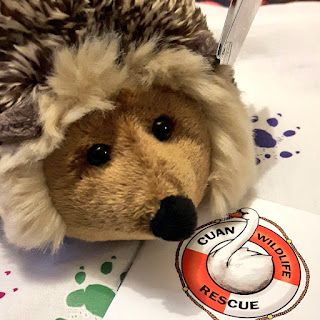
Last year Cathy and I adopted or sponsored or supported an animal every month through various organisations and agencies. We have decided to continue this year. Our January adoptee was a hedgehog through Cuan Wildlife Rescue in Shropshire.


In return for a donation we received a toy hedgehog, and a few other bits and pieces including a hedgehog heroes tea towel, an adoption certificate and Cuan's latest newsletter. Cuan cares for literally hundreds of hedgehogs each year, along with numerous other animals ranging in size from tiny shrews up to deer. In total over 20,000 animals were cared for in 2021.

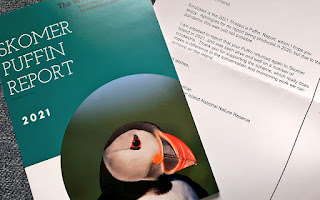
We have also had an update on the puffin we support through the Welsh Wildlife Trust. In addition to a lovely little annual report, the letter they sent confirmed that "our" puffin had been spotted on Skomer Island on a few occasions. 


The report was full of interesting information - including a story about a puffin they spotted with a ring the researchers didn't recognise. It turned out it had been ringed under an old scheme when it was a chick in 1992! I've got adult friends who are younger than that! The survival rate for puffins is about 91 per cent, so almost 1 in 10 puffins don't make it through year on year. The one born in 1992 had beaten the survival odds three times over.

As an aside, years ago I worked in charity communications, so I always look at materials like this from a professional point of view. This update really worked in connecting me with the orgnisation. It was personal, because it mentioned "our" puffin, and it explained how our support was making a difference without a hard sell to continue that support. But the feedback and the nicely presented additional information has made me feel very positive about continuing to support the organisation. And I'll admit the photos of puffins help to sell it too. 

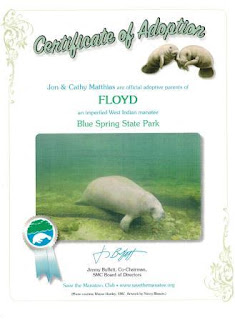
When I rounded up all our adoptions from last year, I said the December adoption was on its way. I didn't know where it was coming from bacuase Cathy had arranged it as a surprise. It arrived today and what a surprise it was - an adopted manatee through the Save the Manatee Club. We are now the adoptive parents of Floyd, who is almost as old as we are.


Floyd is apparently a bit of a character who will sneak up and barge photographers trying to take pictures of the manatees. He has some scars and has lost a chunk of his tail in a boating accident. Visiting the manatees at Blue Spring State Park in Florida is one of the things on my bucket list - hopefully Floyd will be there when we visit!

Thursday, October 20, 2016

Yes, you can polish a turd

Yonks back my very good friend, Matt, informed me that I was correct when I said you can't polish a turd, but, he went on to say, you can roll it in glitter!

Anyone who has spent any time in a communications department knows that sooner or later you will have to pick up the glitter and start rolling. That great idea for an ad campaign that the CEO has had in the shower that morning and now you have to make it work? Pass the glitter. That begging letter the head of finance loves because it's full of stats about how much it costs to run the charity for ten minutes? Pass the glitter. (True story - I wrote a letter that was a real heartstring-tugger which came back turned into something like a cross between a maths lecture and a shopping list. The letter bombed and a few months later I was out of a job.) Someone has had a great idea to do "something" on Facebook and "make it go viral"? Crap, we've run out of glitter.

"Roll it in glitter!" became one of my favourite catchphrases until I discovered it was possible to polish turds. If you leave it long enough. Corprolites are fossilised dinosaur poos. Over time, with a bit of pressure, the dino dumps have been turned into stone. You can find them for sale all over the web. And do you know what's special about these pleistocene plops? You can polish them. (as can be seen at the Poozeum.)

So there you go. Next time someone tells you that you can't polish a turd you have a couple of options. You can reach for the glitter. Or bury it for a hundred million years.

Tuesday, March 08, 2016

Timing - a crucial element in marketing

We get some random leaflets through our door. I've critiqued one before for various marketing fails. But this rather weird leaflet we received recently illustrates another really important point about marketing: the importance of timing.

All these dates had gone

We got this through the door on about the 20th February. All bar one of the events that were advertised had passed.

Still time to go to one...!

The only one that we could still make was 'The origins of universal knowledge', which is a real shame because clearly the one about geomagnetism and ley lines would have been the most interesting.

(Realistically I know I wouldn't have gone to any of these. I would have liked to. Crazy things like this amuse me. For £3 it would probably have been great value even though I have enough on without going along to stuff like this for a laugh.)

But the point is, because of the timing, the leaflet was useless. I'm not even sure why they bothered paying to have them delivered at all if five of the six events had gone. Maybe they got ripped off by their distribution company. Maybe they had a load of leaflets left and were desperate to get people along to the last one in the series. Who knows? But I doubt it worked.

Timing is critical in marketing - when you make the offer often determines whether people take you up on it. There's good evidence, for example, that marketing emails don't do well on a Monday or a Friday. I often question the timing of TV adverts for special offer weekends, which are broadcast after 6pm on a Sunday when all the shops are shut. Why show it then? It's just a waste of the marketing budget.

It's very easy to spend a lot of time and effort thinking about your message, just to sabotage yourself by sending it out at completely the wrong time. The only thing more useless is sending it to completely the wrong prospects. I'm going to keep an eye out for an example of that.

Other comms & marketing posts
Making communications work: Always do the 'Comms around the Comms'
What makes TV adverts memorable: Some nuggets from psychology research
Marketing b*llocks! The "Camel Balls" bubble gum branding case study

Tuesday, March 01, 2016

Dissecting bad marketing: When people forget WIIFM

The golden rule, cardinal rule, absolute must do, total imperative of marketing is this: it is all about your customer.

There's an acronym: WIIFM. What's In It For Me? When a prospect reads your copy they should know what the BENEFIT will be to them from buying your product or service.

It is that simple.

I got this email recently from a company. I started reading it, got bored and deleted it. Then I thought 'Actually, this would make a case study of poor marketing.'

Here's the email with the identifiers removed:

Dear Jon,
We are delighted to announce that in 2016 we shall be celebrating our 30th Anniversary.

To mark this significant milestone we have given our brand, website and literature a complete makeover; one that we believe helps reflect our heritage and our aspirations.  Our new logo is simpler and cleaner whilst continuing a theme that has represented our business for the past three decades.

We are very proud of our staff, our customers and our products so it is important that our brand represents this; indeed it is through our brand that we get to share with you who we are, what we do and where we are going.

We work across a number of industries and sectors, delivering expertise and software solutions that meet our customers’ needs, which, in turn, helps them achieve their own goals.  We believe our customers have their own unique requirements and they deserve a friendly, adaptable and professional approach.  It is this that drives us and is core to what we do.

We are all very excited about our new look and the opportunity to share more about the work we do and where we are going.  Please take a peek at the new website: [redacted] where you can learn more about our products and services and gain an insight into our mission and goals.

We would like to take this opportunity to express our appreciation for choosing [redacted] and for your continued support.  We look forward to working ever more closely with you for many more years to come.    
Regards,
So here's your challenge. Tell me:
a) what does that company sell?
b) what benefit I will gain from using their services?
c) what is the point of this email?

Seriously, someone bothered to send me an inbox-clogging email telling me all about how excited they are about their new logo. Wow, a new logo. Big furry deal, as Dogbert would say.

Let's dissect this and see where exactly it falls down.

It starts with my name. That's actually good. Email personalisation helps make emails more readable.

Then it says they are celebrating their 30th birthday. OK. Not important to me.

Then some blah, blah, blah waffle about how great they are and how they plan to celebrate. They use 'our' 10 times and 'we' 6 times before the first use of the word 'you'. That's how much you, the reader matters. The ideal marketing copy would be the reverse of that.

In fact, here are the total word uses
'Our' = 16
'We' = 15
'Us' = 1
'You' = 3
'Your' = 1

That's a ratio of 8:1 (32:4) words about me compared to words about you. There are some glaring missed opportunities to rebalance this. 

"We work across a number of industries and sectors, delivering expertise and software solutions that meet our customers’ needs, which, in turn, helps them achieve their own goals.  We believe our customers have their own unique requirements and they deserve a friendly, adaptable and professional approach.  It is this that drives us and is core to what we do."

could be rewritten as

"By working across a number of industries and sectors, your needs will be met through applied expertise and software solutions that help you achieve your goals.  As a valued customer, you have your own unique requirements and you deserve a friendly, adaptable and professional approach. You'll find this drives us and is core to how we work with you."

That replace a 6:0 ratio of me-you words with a 2:8 ratio. Still not great, but much more compelling and it means exactly the same thing!

I'd also question whether it is through their brand that they share with me who they are, what they do etc. They will probably have to explain all that stuff. Brands are actually very poor communicators. You know what are good communicators?

People.

There is a tendency to see email marketing as less selling and more about building relationships. But this email doesn't even do that because it is totally one-sided. It's not a relationship; it's just them saying stuff, completely oblivious to the needs, wants, feelings of the people they're talking to.

It is also a wasted contact. What is gained by sending an email to all your prospects about something as pants-boringly useless (to me) as your new logo? I can understand you wanting to go 'Squeee!' with excitement, because having a new logo is a BFD to you. But it means nothing to me. Why would I care? What's in it for me?

And even if I accepted this was a useful and relevant thing to be communicating with your customers with, it's not even a good communication because it's all about you. But if you want my attention it should be all about me.

It's the golden rule. Tell me the benefits. Tell me what's in it for me. Otherwise it's just a crap waste of inbox space.

Read more
Put your benefit front and central
Analysing takeaway menus for marketing fails

Thursday, February 18, 2016

Marketing tip: Put your benefit front and central

Cathy saw this on the shelf at the supermarket and said, 'Well, that gets straight to the point'.

To the point

And she's right. It gets straight to the point and gives you the product benefit right there. It "Stops Smelly Sinks."

I think this is great marketing. If I had a smelly sink I would want a product to stop that. Seeing it made me wonder if we had a smelly sink. I was in the supermarket. I couldn't go and sniff the sink to check. I was tempted to buy it just in case. Maybe I could use it to make sure my sink didn't become smelly.

The first rule in marketing is tell people about the benefits, not the features. I don't want to know what it's made from, or what the active ingredients are, I want to know what it does or, more importantly, what it will do for me. This marketing puts the benefit front and central. I know if I use this it will stop my sink from smelling. It's clean and efficient marketing copy and I think it's great. Well done, Buster.

(I mean, I didn't buy it. But if I have to sort out a smelly sink in the future, then I probably will.)

Other posts about marketing
Analysing takeaway menus for marketing fails
'Marketing b*llocks' - the Camel Balls gum case study
Branding brilliance: How to make your Death Metal band stand out


Monday, February 08, 2016

Communications, innovation and choosing who to work for

The best content out there is always other people's, which is why I'm happy to be a signpost. Here are some interesting nuggets of workplace wisdom I have come across this week - one that is more general and some that seem very handy to people working in the NHS.

The first comes from Michael Katz, with his recommendation to avoid working for desperate clients. I like the analogy of visiting the supermarket with a rumbling tummy - you regret it later when you are full. When the crisis is over, your employer may feel differently than they did when they hired you back when they were at peak stress. Michael delivers it with his trademark wit - well worth a read.

I sent it on to my friend Matt because we have had discussions like this about clients who turn out to be difficult. One of the truest things I learned from Mark H McCormack's books is to not be afraid to fire your customers. Sometimes you have to sever the ties with someone who isn't paying you enough for the amount of hassle they cause. Matt and I agree on this and I knew he would like Michael's take on not working for the wrong customer.

Matt responded with two links of his own. The first to a blog by Seth Godin that talks about marketers being hampered by their own organisation. This really applies in the NHS, where everyone says we desperately need innovation and transformation but it's equally desperately hard to innovate and change anything.

Seth adds a bit at the end about knowing when to give up: Good marketers have "The willingness to quit what isn't working." Yes, we need to learn that, but it's tricky though because you're caught between throwing good time and effort after bad and the sunk cost bias of getting nothing back for all your expenditure. It's hard.

The second link was to a brilliant TED talk about how the 'rules' charities have to operate under limit their ability to actually tackle issues. Everything in this video is true for the NHS, with the newspapers ready to pillory any risks that go bad or salaries that are considered 'too high'. It's 18 minutes long, but worth watching.


Then finally something popped up in my Twitter time line that originally came from Helen Bevan, who does a lot around innovation and improvement.

We need to get good at this

I would like to see this happen because social learning and application must be the way forward for us in the NHS. Go into any office and the shelves are full of toolkits and learning papers full of ready to apply knowledge, slowly dessicating with neglect. We need a better way of talking and sharing. This slide seems to give us the evidence to try doing it differently.

Monday, February 01, 2016

Making communications work: Always do the 'Comms around the Comms'

In 2015 I left my comms job and became the Network Co-ordinator for an all-Wales clinical network. It's not a complete change. I've taken some of those comms skills with me and I recently helped produce a video project working with some members of the network. We were quite pleased with the results, given our shoestring budget. Here's one of them:


It was a great feeling to have the videos filmed, edited, tweaked, and then finally signed off and loaded up to YouTube. You can watch all four on our website.

However, one of the big things I learned in my previous job was that the end of the project - when the product was polished and perfect - was when you needed to kick in with the actual 'comms around the comms.' It's easy to make the mistake of thinking the end result is the end of the work - I've done it! I've produced a lovely report, or a shiny video, or a glossy resource. I've put it on our website. I've thought my hard work is done.

Sorry, no. The hard work is not done. This was my comms plan for after we went public with the videos.

Comms around the Comms

It's not enough to produce the content; you need to get it read or watched or seen. How do you do that? Here are some of the ways I approach this.

1) Identify your channels
Count your channels - do you know what you have available? You might be surprised.

Aggressively promote it on your own channels - tweet it frequently using a scheduler.

Don't just rely on your channels, use other people's channels too, which leads to point 2.

2) Ask people to promote it
Send personal emails to all your contacts asking them to look at what you have done and tell others.

Be explicit in what you are asking for. Not just 'Could you tell people about this?' but 'Could you tweet this and put it on your Facebook page?' The worst that would happen is that someone will say 'No', but to make it more likely that they say 'Yes', make sure you do point 3.

3) Make it easy to share
Write tweets for people; write content for websites, lines for blogs, whatever.

Pre-empt people's needs. In Wales, people will need a Welsh version. Get it translated.

Make it relevant. Why would another organisation share your content for you with their audience? Emphasise the connection you have - for example, we had staff from different organisations involved so the web story was tweaked when we asked those organisations to share the content.

4) Engage in the dark arts
Do the SEO work on YouTube. It sounds obvious but you need to make it easy to find. Write a description. Use meta-tags. This is a bit more technical and probably won't make as much difference as a nicely-worded email to 50 colleagues. But it all helps.

5) Revisit
Keep coming back to it. Repeat your messages. Follow up with people who didn't share it - people are busy and forget. Don't be afraid to send a friendly reminder.

Saturday, January 23, 2016

What makes TV adverts memorable: Some nuggets from psychology research

I’m currently studying a part-time MSc in Business Psychology and we have moved on to a module about ‘external communications’. Branding and advertising, in other words.

Stars of a memorable TV ad...
I've been reading a number of papers while preparing for my first essay assignment. For fun, and to spread the knowledge, I’ve pulled out 9 factoids about TV advertising that have been evidenced by psychological researchers. Spot how many of these are true for you and how many techniques are being used by the broadcasters.

TV ads are remembered more if they are followed by ‘congruent programme content’, e.g. a beer advert is followed by a scene where people drink beer. (Furnham et al 2002)

However, TV ads are remembered less if they follow ‘congruent programme content’. (Furnham et al 2002) This means smart script writers would want to know what ads are going where to put all their congruent scenes in the right place. You want your scene in a pub after the beer advert, not before.

People are more likely to remember longer adverts than shorter ones. (Pieters & Bijmolt, 1997)

Stick too many adverts together and it’s more likely none of them will be remembered particularly well. Increasing the number of ads in a block from 4 to 5 begins to negatively impact memory. (Pieters & Bijmolt, 1997)

However, brand recognition afterwards is not reduced by having more adverts. People might not be able to consciously recall the advert, but the brand name is lurking in their brain somewhere! They will recognise it if they are shown it later. (Brown & Rothschild, 1993)

Don’t bother running your ads in the middle of commercial breaks. People tend to remember the first and last adverts in a sequence. (Terry, 2005) This is true even if they are the exact same adverts, just shown in a different order.

People are also more likely to remember adverts that appear in the earlier commercial breaks in a programme, than in ones later on. (Terry, 2005)

Leaving very short gaps between TV ads makes them easier to remember. (Pieters & Bijmolt, 1997) This one is clearly being used on a lot of channels these days. The break in programming catches our attention as viewers. Probably.

The BBC would make a killing if it could flog space in the middle of East Enders. Advertising content placed in ‘happy’ programmes was not remembered as well as in ‘unhappy’ content. (Furnham et al 2002) The effect of an unhappy programme is magnified if the advert is violent and/or offensive. (We are lovely people, aren’t we? Remembering violent adverts in miserable programmes.)

References

  • Brown & Rothschild (1993) "Reassessing the Impact of Television Advertising Clutter," Journal of Consumer Research, Vol. 20
  • Furnham, Bergland & Gunter (2002) "Memory for Television Advertisements as a Function of Advertisement–Programme Congruity." Applied Cognitive Psychology 16
  • Pieters & Bijmolt (1997) "Consumer Memory for Television Advertising: A Field Study of Duration,Serial Position, and Competition Effects." Journal of Consumer Research. Vol. 23
  • Terry (2005) "Serial Position Effects in Recall of Television Commercials." The Journal of General Psychology, 132(2)


Tuesday, June 30, 2015

1000 Lives - a work retrospective

Today was my last day at 1000 Lives Improvement. It's been five years and it was definitely time to move on. However, it's hard to say goodbye to people you have worked with and grown to care about. As Cathy pointed out, five years is the same length of time I was at secondary school. It's longer than my niece has been alive! So, it is a significant chunk of time.

Anyway, here are some high points...

Count me in
This was a big campaign shortly after I started to maintain the momentum of the 1000 Lives Campaign in the new 1000 Lives Plus programme. This photo is notable for my mini-sideburns and the blue jacket that I wore a lot to work events.


The STOP Campaign
This was the first time we really built comms into a clinical change programme. The mascots were fun to develop, especially the catheter (first time round it looked really rude). STOP won a CIPR Pride Award - I wrote a report on it if you want to know more.


Champions for Health
Another big campaign, this time looking at improving the health of NHS staff and encourage them to become advocates for healthier lifestyles. I took part in the pilot. (Blue jacket in the photo!)

World Sepsis Day
One day I will blog about the car journey I had with Terence Canning, the Welsh ambassador for the UK Sepsis Trust. On that journey we coined a phrase that has appeared on numerous awareness-raising materials and has even been borrowed by other organisations. I had the poster on my wall by my desk at work as a reminder that good writing is often short writing.

We also interviewed Terence for one of the videos we shot for World Sepsis Day.


The International Forum - London
Probably one of my favourite weeks at 1000 Lives was manning the NHS Wales at the IHI International Forum in London in 2013, with my lovely friend Kelly. Almost unbelievably, having spent 15 hours a day in each other's company we ended the week better friends than when we started. On the way down we decided our names weren't Welsh enough so we adopted the names Iolo and Myfanwy. Little did we know those names would stick.

At the end of the week we posed by the London Bus they had in the main auditorium. You can see how tired we were.

Dr Olivia
Towards the end of last year I spent nearly six weeks working on placement in Aneurin Bevan University Health Board. What with a Daily Mail hate campaign against NHS Wales, rumours about ebola, and a grisly incident involving a possible patient, it was a chance to experience the deep end of NHS comms.

We also got to film Dr Olivia's Guide to A&E - Is it really an emergency? I'm not sure how many videos I produced while at 1000 Lives. It's well over 100. This is one of my favourites.


Publications
In the past five years I've written six annual newspapers (plus three others) and 14 white papers. These are the latest ones.


Legacy
I've left these on my desk to intimidate my replacement. 3 gold awards in 2 years is a pretty good return. (As the person who wrote the entries as well, I felt doubly satisfied with the wins!)


So, those are just some highlights. There were many more. It's been a good five years.


Monday, March 30, 2015

Interesting developments in communications

I've been seeing some interesting charts and diagrams on Twitter over the last few days, which anyone who works in Comms may find useful. Here are three of them. Obviously all the copyright remains with the organisations who created the diagrams, but as they've tweeted them, I hope they won't mind me reproducing them here with proper attribution.

First up is this breakdown by Microsoft of PC v mobile usage. (Edit: the blue is PC and the pink is mobile in the graph.) The main learning point is that very few people use mobile devices for email. In work we have recently talked about optimising our email newsletters for mobiles, but I now wonder how much we should be concerned. Obviously we want to make sure they are readable, but the assumption that everyone gets email on their mobiles isn't accurate. 

Click the image to embiggen it to readable size

On the other hand, using social media to drive traffic to websites requires making sure the website is optimised for mobile as 66% of social networking usage is on mobile devices. Two thirds of  SoMe consumers will potentially be clicking through from a mobile device. That has implications for website design.

The next graph is from The Economist and shows how Whatsapp is overtaking SMS text messages. What’s also interesting is how SMS has plateaud and even fallen back slightly. 


This usage graph suggests that Whatsapp may give you as much reach as SMS if you were exploring a new comms channel. Although you’d need to know more about user demography. I suspect Whatsapp is still very much an under-30s medium, a bit like Instagram. (These are my suspicions, I haven't checked to see if there is data out there. I'm basing my assumption on the people I know using either Whatsapp or Instagram.) 

We also still don’t know if Whatsapp’s growth is a bubble that may burst when something new comes along. But what it does show is how quickly a new comms channel can develop. In three years it is reaching the heights it took SMS almost 20 years to reach.

The third diagram has been created by Hootsuite and I really like it. It’s a honeycomb of user experience to guide the creation of web content that will engage people. 


I don’t think this is limited to creating content for websites. I have seen a lot of material produced that tick off none of these characteristics. I may even have been guilty of producing some myself - that web-page that someone has requested because they want a web-page rather than for any compelling user-oriented reason.

As a final thought, I wouldn't have seen any of these if it hadn't been for Twitter. People don't often regard social media as a learning channel, but I find more and more interesting stuff that makes me think turning up in my feed these days. There is a lot of data out there to drive good comms. It's just a question of noticing it.

Friday, April 11, 2014

The Online Influence #Oi14 Conference – some bits that stood out

Yesterday I attended the Oi (Online influence) Conference in Cardiff. Here are some bits that struck me as useful during the day. I have tried to include one quote and one tip, although not everything on the programme made the cut here.

David Hieatt, Hiut Denim, Keynote speaker
Quote: “It’s your job to make your ideas happen. No one else will.”
Tip: Fail fast. If something doesn’t work, kill it quickly and try something else.

Dennis Bree & Dave Shaw – Twitter masterclass
Quote: “Twitter is the live second screen.”
Tip: Plan for the ‘moment’ and be ready to act on it.

Diana Memic & Michael Complojer - Google+ masterclass
Quote: “Everyone is posting into a noisy space.”
Tip: When posting, pause and clarify your goals.

Dan Spicer – Hootsuite masterclass
Quote: “Do one platform really well, not five badly.”
Tip: Empower your team and turn all staff into advocates for your brand on social media.

James Eder – Student Beans, Keynote
Quote: “Stop marketing and start mattering.” (I really liked this line!)
Tip: Face-to-face is costly, but incredibly valuable.

Michael Brackpool & Ben Hackett – Brandwatch masterclass
Quote: “Just because you have a larger haystack doesn’t mean you’ll find more needles.”
Tip: You need to know if negative comments are significant.