Tuesday, June 25, 2024
It seems "Jaffa" has lost all meaning
Sunday, June 23, 2024
Toys R Us R Back (sort of)
Wednesday, January 03, 2024
Snack of the month - cola pop...corn?
I tried this snack last month, before Christmas. But it's still on sale in B&M if you want to try a bag yourself.
There is a trend now for stretching confectionery brands across other products to take advantage of brand recognition and customer loyalty. Chupa Chups isn't a brand I'd have thought would have a high amount of either but the manufacturer obviously thought differently.
The popcorn had a decent crunch with the cola flavouring adding a thin sugary coating to it.
It tasted like cola bottle sweets rather than a fizzy syrupy drink. I thought it had quite a pleasant taste although the high sugar content means I probably won't buy it again.
Friday, December 31, 2021
December 2021 - End of month review
This is my final monthly round up for 2021 and my final blog post for the year, taking me up to an annual total of 92 posts.
December for us is dominated by Christmas. We wrote about 120 Christmas cards. Cathy took a picture of me posting a load of them outside our local post office, where the postbox has been decorated by someone with excellent crocheting skills!
I was in work right up to Christmas Eve, then Cathy and I had a quiet Christmas Day. Two days later we went up to Shrewsbury and had some days with family before heading home to ring in the New Year. While in Shrewsbury I went to a football match at the Meadow for the first time since March 2020. It was an evening game that ended in a 0-0 draw, but it was so good to be back there! Here is a photo of the team warming up.
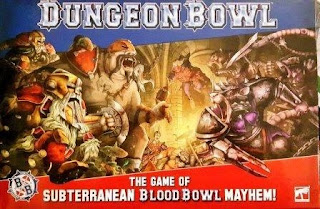
On the way home from Shrewsbury we stopped and called in at the Hereford Model Centre. I bought myself a present with some Christmas money. This will be the subject of at least one future blog post!
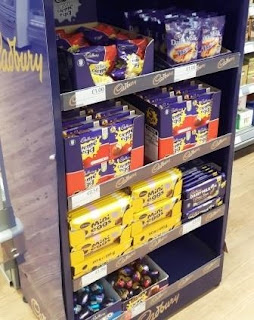
And if the thought of reading about Dungeon Bowl in the New Year doesn't fill you with excitement, then how about this reminder of the next holy holiday that I spotted in a Co-op in Shrewsbury?
That's right! Easter is on its way....
Wednesday, March 03, 2021
Delightful branding
I look at marketing materials that get pushed through my door, as I carry them to the recycling bin. This gem of a product name from a takeaway pizza leaflet made me chuckle.
"Sausage Delight" sounds a bit saucy to me. (Dirty minds and all that.)
Wednesday, March 16, 2016
Neuromarketing - how advertisers could use our brains against us
![]() |
| A neuroscientist, plotting |
Plassmann et al (2015) claim a number of large polling and market research companies with “neuromarketing” departments, used by companies as diverse as the food company, Campbell’s, and the broadcaster, Fox News. While it complements traditional consumer research, Standage and Trappenberg (2012) warn neuroscience is not ready to replace it entirely. There are critics of the neuromarketing approach, such as Addie (2011) who cites the “number of inadequacies” of using fMRI to examine brain functions, and is highly sceptical that neuroscience can actually deliver what it’s proponents claim.
Adopting a cautious approach, Plassmann et al (2015) outline five ways neuroscience could inform advertising strategy: identifying mechanisms, for example what causes consumers to lose control over their buying impulses; measuring implicit processes to explore situations where consumers cannot explain their buying actions; dissociating processes to see which decisions are intuitive reflexes and which are the product of conscious, rational thought; understanding the differences between individuals, which could help advertisers target individuals who are more likely to be susceptible to their messages; and, finally, improve predictions of how consumers are likely to behave. There are also challenges to using neuroscience in this way, including determining whether changes in the physiology of the brain definitely leads to behaviour change.
There have been some applied uses of neuroscience of interest to advertisers. Research reviewed by Kenning, Hubert and Linzmajer (2012) includes that adverts that consumers consider attractive led to brain activity in areas associated with integrating emotions into decision-making and rewards. Adverts rated as highly attractive and highly unattractive were more likely to be remembered. Brain areas associated with ‘rewards’ are also activated when products regarded as status symbols are viewed, with claims that neurological responses to products can then be used to predict purchasing behaviour.
Price has also been shown to have an effect – excessively high prices activate parts of the brain that anticipate losses, reducing the likelihood of a consumer to pick them. Kenning et al propose this could help businesses establish an acceptable ‘price threshold’. Finally, reinforcing the theory outlined by Harris & Sanborn (2014) about sex in advertising, Kenning et al (2012) comment that neuroimaging shows male consumers have the reward centres of their brains triggered by an attractive female face in an advert. This may have implications when businesses are choosing the ‘face’ of a particular advertising campaign.
References
Addie, I. (2011) Is neuroscience facilitating a new era of the hidden persuader? International Journal of Market Research 53(3), 303-305
Harris, R. & Sanborn, F. (2014) A Cognitive Psychology of Mass Communication. Abingdon: Routledge
Kenning, P., Hubert, M. & Linzmajer (2012) “Consumer neuroscience” in Wells, V. & Foxall, G. (eds) Handbook of Developments in Consumer Behaviour. Cheltenham: Edward Elgar
Plassmann, H., Venkatraman, V., Huettel, S. & Yoon, C. (2015) Consumer Neuroscience: Applications, Challenges, and Possible Solutions. Journal of Marketing Research 52(4), 427-435
Standage, D. & Trappenberg, T. (2012) “Cognitive neuroscience” in Frankish, K. & Ramsey, W. (eds) The Cambridge Handbook of Cognitive Science. Cambridge: Cambridge University Press.
Thursday, February 18, 2016
Marketing tip: Put your benefit front and central
![]() |
| To the point |
And she's right. It gets straight to the point and gives you the product benefit right there. It "Stops Smelly Sinks."
I think this is great marketing. If I had a smelly sink I would want a product to stop that. Seeing it made me wonder if we had a smelly sink. I was in the supermarket. I couldn't go and sniff the sink to check. I was tempted to buy it just in case. Maybe I could use it to make sure my sink didn't become smelly.
The first rule in marketing is tell people about the benefits, not the features. I don't want to know what it's made from, or what the active ingredients are, I want to know what it does or, more importantly, what it will do for me. This marketing puts the benefit front and central. I know if I use this it will stop my sink from smelling. It's clean and efficient marketing copy and I think it's great. Well done, Buster.
(I mean, I didn't buy it. But if I have to sort out a smelly sink in the future, then I probably will.)
Other posts about marketing
Analysing takeaway menus for marketing fails
'Marketing b*llocks' - the Camel Balls gum case study
Branding brilliance: How to make your Death Metal band stand out
Monday, February 15, 2016
Marketing b*llocks!! (Literally.) "Camel Balls" bubble gum - a branding case study
![]() |
| Look tasty, don't they. |
Yep, that's right, bubble gum "Camel Balls". I stuck the photo on Facebook with predictable results from adults who were stunned by it and the one teenager who commented saying they were "actually surprisingly good".
In a way, I kind of admire their marketing. These are not sweets for grown ups. No Lindor master confectioner swirling delicious creamy chocolate in a bowl here. No, instead we have a pervy looking camel ready to teabag us with his over-sized camel nads. (Strangely no penis. Perhaps not so strangely...)
I can imagine teenage boys in particular taking great delight in these, and in that sense they are brilliantly marketed. They are deliberately gross - why else the emphasis on being "liquid-filled"? - but they are just about borderline indecent to be amusing rather than out and out offensive. The company know who they are aiming for and they just about manage to do it without making parents testy and writing outraged letters to the paper.
I also love the additional selling points tagged onto the box. These are gluten free, folks. Gluten free! Because the last thing you'd want to have to check is the small print on a camel ball bag to find that out.
What can we learn from this? Know your market and pitch to them. This isn't a product for everyone. And if you are going to be 'gross', then you might as well be as gross as possible. Even though the sweets look disgusting (to me), I like the way the marketing doesn't hold back at all.
Please leave a comment with your thoughts
Read another blog about marketing: The psychological basis for what makes a TV ad memorable
Also: Branding brilliance: How to make your Death Metal band stand out
Saturday, January 23, 2016
What makes TV adverts memorable: Some nuggets from psychology research
| Stars of a memorable TV ad... |
References
- Brown & Rothschild (1993) "Reassessing the Impact of Television Advertising Clutter," Journal of Consumer Research, Vol. 20
- Furnham, Bergland & Gunter (2002) "Memory for Television Advertisements as a Function of Advertisement–Programme Congruity." Applied Cognitive Psychology 16
- Pieters & Bijmolt (1997) "Consumer Memory for Television Advertising: A Field Study of Duration,Serial Position, and Competition Effects." Journal of Consumer Research. Vol. 23
- Terry (2005) "Serial Position Effects in Recall of Television Commercials." The Journal of General Psychology, 132(2)
Monday, January 18, 2016
Branding brilliance: How to make your Death Metal band stand out
| Who wouldn't want to go to Deathfest 2? |
I can't even read many of the names that are all trying to be more-death-metal-than-thou, but I will remember Party Cannon with their bright colours and bubbly font! (Apparently they are from Scotland. There's a track on YouTube if you can bear it.)
The branding lesson is - if you want to be memorable, don't take the existing trope and try to make yourself a more extreme version of it. If anything that will make you less noticeable.
Tuesday, November 16, 2010
Marketing synchronicity