Showing posts with label personality. Show all posts

Tuesday, January 18, 2022

The five dimensions of personality

Time for a business psychology post...

Last month I was asked to present my ‘top tips’ on supporting change, based on my experience managing a network of healthcare professionals. My first tip was to understand that in a complex system, the real complexity is the people working in that system.

One of the things I realised when doing my MSc in Business Psychology is that psychology can be a reductive science. (Particularly if you go down the route of explaining every action by analysing brain activity.) So it’s no surprise to find that generally all human personality is often reduced to five dimensions – usually called the ‘Big Five’. Some people advocate even fewer, and some split some of the five up into other streams.

But for the purposes of understanding people in a work environment, the ‘Big Five’ are all you need. There is also a handy acronym to remember them by – OCEAN.
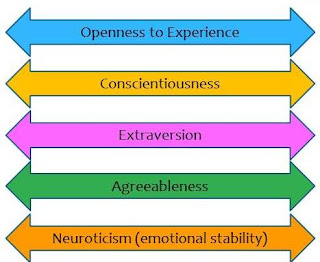

The five letters of OCEAN represent

  • Openness to Experience
  • Conscientiousness
  • Extraversion
  • Agreeableness
  • Neuroticism (emotionality)

All five of these personality dimensions are continua. We all display greater or lesser aspects of them. The assumption is that as most people grow up, they stabilise in places on the various continua. If they were cautious children they will be cautious adults and display less openness to new experiences or curiosity about the world. Personally I think it’s a mistake to assume that people will always act a certain way. Some people seem to compartmentalise their lives and exhibit very different approaches in work to outside work. They may be very risk averse in work and compensate for that with risky behaviour in their hobbies and pursuits. 

There is no real right or wrong place to be on the continua, but people who operate on the extremes are more difficult to function with in work.

For example, people who are extremely open to new ideas and curious about trying new things can be great at innovation and fixing systemic problems. However, they can get distracted. They often leave projects half-completed. They can go down research rabbit holes. And they are often susceptible to sales pitches and latch on to magic bullets that will solve all their problems.

At the other end of that continua are the joyless jobsworths who were told how to do a job a certain way on day one of their employment and will retire 45 years later doing the same job the same way. It’s really easy to spot those people. Just ask them why they do something the way they do it. If the answer is “We’ve always done it this way”, then they have low levels of openness.

Conscientiousness is often seen as a good trait in a co-worker or employee, because, obviously, nobody wants to be working with reckless people who don’t care about anything.  However, overly conscientious people can become obsessed with procedure, to the point where they are paralysed into inaction for fear of doing something wrong.

Extraversion and introversion aren’t exactly a continua. Introverts can do what extraverts do; it just takes more mental effort. Extraverts don’t get worn out by people as quickly. You can easily spot extraverts and introverts because the extraverts want everyone to go out to the pub after work, while the introverts just want to quietly slope off home. (There's a topical point to be made here about party-keen extraverts being more likely to have an office wine fridge filled by sloping off to the off-licence with a suitcase to buy booze.)

Extraverts are energised by people, so are often regarded as enthusiastic and keen, geeing up the team and pulling everyone forward on a project. Those are all good things. But in my experience, because extraverts are energised by people, they tend to do work in meetings and task groups but not between meetings. They can be very productive in the group environment, often banging out plans and strategies in a short time.

In contrast, introverts find it hard to make decisions in meetings. They often want more time to consider things and weigh up options, backed up by research. Typically, they will go back to their desk and start actioning the list of things that need doing, which they will bring to the next meeting. A good team will have both types of people in and a good manager will recognise that they need to feed the extraverts with group time and protect the happiness of the introverts by giving them space.

Agreeableness is an interesting continuum, and one that I feel has capacity for people to be at different points on the continuum depending on context. Generally, agreeable people are much nicer to work with. They make the team environment more pleasant. However, it’s possible to be too nice and this can impact on productivity directly, with too much social chatter and concern about non-work conversations, and indirectly if people are seeking a consensus before making progress. Sometimes movement happens when a person with a lower level of agreeability decides to take initiative even though a few noses will be put out of joint. 

Another way that highly agreeable people can cause problems is through enabling toxic behaviour. I have some experience of people with high levels of agreeability whose main role in a team seems to be smoothing feathers ruffled by more disagreeable members of the team. This prevents confrontation and means that the more disagreeable person is never held to account for their actions that are upsetting people, so they continue to function in the same way. In the long term that poisons relationships.

Finally, neuroticism is about how deeply a person feels emotions, not necessarily how much they express them. Some people display flashes of anger, then very quickly regain an emotional equilibrium and move on. Other people don’t express emotion and internalise a large amount of stress and resentment. There is some debate whether neuroticism should really be in the Big Five, because it seems more liable to fluctuation than the other dimensions.

It’s also the only dimension where lower levels are considered more beneficial in a work environment. Generally, people who are overly emotional and get very stressed over every issue they face are not easy to work with. However, I would be wary of people who never express emotion. They may seem like unflappable bastions of resilience, but it might just be a case that they don’t express emotion because they don’t feel things like empathy and compassion.

There are loads of different activities that can help reveal people’s tendencies on the Big Five continua. If you have ever sat through an ice-breaker that will designate you as an animal, or a cartoon character, or assign you a colour, you have probably been profiled in some way. It’s then up to the managers to observe the outcomes of those activities and tailor their approach to fit. Although, the ability to do that successfully, is, of course, dependent on where the managers themselve are situated on the various continua!

Sunday, January 17, 2021

When all our cells change why do we expect to stay the same?

This post has been sitting in my draft folder since January 2017. Given some recent conversations I've had, I feel like it's worth an airing (with a few minor edits).


I find New Year quite melancholic. It's a time to reflect on what's happened and look back on stuff. (In 2017, for various reasons, I ended up looking back a bit further than normal. This is mainly because of reconnecting with some people I had been in school with over two decades previous.)

I journal offline as well and reading old journal entries, or my old blog posts on here, sometimes makes me feel like I'm reading about a different person. Douglas Coupland warns us that nostalgia is a weapon and sometimes I can turn that weapon on myself by thinking about the past and about how much has changed.

The thing about change is that it's rarely in huge increments. Yes, some are life-changing and can happen over a few short days (for example, diagnosis of a chronic illness), but most of our changes - in attitudes and priorities - happen slowly.

I read somewhere that all the cells in our bodies are renewed every ten years or so. I've been in a relationship over 25 years. I'm a whole new man. In fact, I'm the second whole new man to have been in the relationship. An entire version of me has died off and been replaced. And we didn't even know it.

Or did we? I'm not the same person as I was 25 years ago. Experiences and achievements, wins and losses, have made their mark. I feel a lot less certain about some of the things I was so certain about back then. Things that were once important don't matter and things that never used to matter to me suddenly seem important. How much of this is just the weight of living pressing down on me and how much is actually physical? Feelings of attachment and abandonment originate in brain cells that change like any other cell. As my cells change does that have an effect on my opinions?

There's a couplet in an Avett Brothers song that goes: 
I want to have friends 
That I can trust 
That love me for the man that I am 
Not the man that I was. 
I really like that lyric because it shows how we can be perceived as the person we were in the past, even though we have changed. That can be a battle if we have grown up, if we react differently now, if we have different priorities. When people assume we will always act a certain way that can be constraining and they may not like it if we do something they don't expect.

There's also a danger in such expectations. If we know we are loved because of what we were when we were first loved then it's hard to say we have become something different. We become inauthentic versions of ourselves, afraid to admit what we really feel or think or believe at this point in time, in case it turns out the people who love us love us because of who we were then, not who we are now.

It's hard to see people for who they have become. If we have friends and loved ones who do see us for who we are and not who we were, then we are very fortunate.

Thursday, January 14, 2021

Divine personality types in the workplace

I was sorting out my home office over the Christmas and New Year break and was distracted by one of the books I acquired while doing my MSc in Business Psychology. It’s a book called Inside Organizations by Charles Handy, a companion book to a TV series from 1991.

The book offers 21 ideas for managers, and is a mix of organisational psychology ideas. Quite a bit has changed in terms of working environments in the past 30 years, but a lot of the book is about working with people, and people haven’t changed that much. 

One chapter is entitled ‘Find your God’ and Charles borrows from the ancient Greek pantheon to illustrate four different workplace personality characteristics. I’m a bit sceptical of profiling tools like this as I feel there are way more than four blends of personality traits which create different people. But it’s an amusing diversion and I was intrigued by the religious angle.

Charles starts off by commenting on the diversity of religious expression in the classical world and outlines his thoughts that like-minded people were attracted to the veneration of the same gods so met people similar to themselves in the temple they chose to attend. I’m not a hundred per cent convinced that there was that amount of free choice in religious observance in the classical world, but broadly speaking he has a point. 

Furthermore, he theorises that certain personality types were attracted to certain deities based on the personality type of the worshipper. In some ways we see this play out in organised monotheistic religions as well. Different groups emphasise different teachings and different aspects of God’s personality within world religions, which is why we get schisms and sectarian disputes, even wars. And different groups attract different types of people – authoritarians are drawn to authoritarian structures, for example.

The four gods Charles identifies as work personality types are:
Zeus – the leader with “personality” who wields power and expects people to follow orders and deliver results
Apollo – the god of logic who wants everyone to follow the carefully delineated rules 
Athena – the goddess of warriors and adventurers, with an emphasis on team-working and a fascination with innovation
Dionysus – the god of excess, although Charles describes him as the “god of the free spirit”

There are probably aspects of all four gods that appeal to everyone. Zeus-type personalities place great store on selecting the right people to build a team of skilful experts who they can rely on. I have always informally done that, and have built up a network of people I know will help if I need it. The routine, security and predictability of Apollo-type personalities can also be comforting at times. Uncertainty isn’t conducive to long-term happiness or productivity. That’s one lesson we all learned from 2020! I also value being part of a high-functioning team sharing delivery of objectives, like the Athena-people. When I look back at the times when I have felt the most satisfied in work it is usually linked to being part of a smooth-running high-performing team. 

But the one god whose characteristics most resonated with me was Dionysus. Charles is very careful not to describe Dionysian rites which focused on drinking lots of wine, probably because that doesn’t sound like very professional behaviour. Instead he describes Dionysus-people as the ‘free spirits’, who tolerate working in organizations as long as the organization doesn’t get in their way. 

He sums this up, saying “they see the organization as serving them rather than the other way round”, which is something I have often thought with regards to bureaucracy. To borrow from Christianity for a moment, is the Sabbath made for man, or man made for the Sabbath? In other words, do the processes exist to help people do their jobs, or do people end up having to complete endless forms in order to feed the bureaucracy? 

A slightly more positive way of framing that is people choose to work in organizations so that they can do the job they love to do. Charles specifically uses doctors as an example of free spirits who tolerate the organization’s existence, because it’s hard to practice medicine outside a healthcare organization. (It’s not impossible, the extreme Dionysus-people doctors are probably working in a remote field clinic for an NGO somewhere.)

As someone who finds satisfaction in planning and delivering communications, the way Charles describes the Dionysus-people feels very natural. He identifies some key aspects of their approach to work that I recognised in myself.

“To a Dionysian, the quality of the work is paramount... They are craftsmen obsessed with their craft, uninterested in power or position as long as they have enough to guarantee them their freedom to work as they wish.” 

I really concur with the obsession bit. When I was tidying up the office I found a folder of samples of promotional material that I had kept for inspiration. I also found a ring-binder full of good copywriting techniques and tips that I had gathered from a number of different places. I did that on my own initiative because I wanted to improve as a writer.

I’m not sure about being uninterested in power or position, but if that means not being impressed by other people’s job titles, then, yes, I have a history of saying frank things to people much higher up the organizational structure than me. However, I definitely value autonomy in my work and in the past have struggled with very directive management. 

Charles goes on to say that Dionysus-people are team players “when they have to be” although they “prefer to be left alone to get on with work in their own way.” They are “loners” and as people they “seek respect, influence and freedom.” There’s an interesting distinction there between ‘influence’ and ‘power’, which reflects changes in terminology since the book was written. I think now ‘influence’ would be seen as ‘soft power’, with potentially more to be gained by influencing people who hold powerful positions than holding those positions oneself. 

I also wouldn’t describe myself as a loner, but I am an introvert and I do like time by myself. 

Charles concludes that organizations find Dionysus-people “uncomfortable” and that they don’t respond to the usual people-management tools like promotions or reprimands. He says, “They seem to have a loyalty to their craft or profession which overrides their commitment to the organization.” This makes me think of doctors who act as whistle-blowers to expose deficient care, or military personnel who leak documents to reveal cover-ups and war crimes. 

Organizations have changed massively in 30 years. When Charles wrote that book, email was not present in many organizations and the interconnected nature of modern-day working would have been regarded as futuristic fiction. But as I said, people are still people, and personality types still impact heavily on the way individuals work in organizations. If the gods of ancient Greece are archetypes, which is certainly a valid way of interpreting those religious expression, then those archetypes probably still apply.