Showing posts with label science fiction. Show all posts

Sunday, June 21, 2026

Book of the Month: The Mountain in the Sea

This was an impulse purchase in a TK Maxx earlier this year, because, well, octopuses.

It's a slice of speculative fiction set in the near future. Political entities and alliances have shifted, big tech companies run the world, and the boundary between human and machine intelligence has broken down. In the middle of all that a scientist fascinated by octopuses is invited to study a mysterious new species that may be sapient.

The scientist is aided by the first true android who may, or may not, be a conscious being. It is the subject of fearful hate and has been banned from most territories on Earth, so is working on the octopus project on a remote island atoll to keep it out of harm's way. Other forces are seeking to access the islands - one for the mysterious octopuses, and one just to harvest the fish that live in the protected zone.

As a 'first contact' story between two species that think very differently, this works pretty well. But there are some other story threads interwoven which are distracting.  I felt the storyline about a human crew enslaved on a fishing boat captained by an AI was horribly feasible but was superfluous to the overall plot. 

There are several conversations that act as exposition. Mini-monologues that explain certain things that, in-world, probably wouldn't need explaining. But generally that's my only real gripe and the exposition moves the story along rather than holding it up.

This is a very grounded science-fiction book, based on what we currently know about octopuses and the fascinating way their brains work. I felt like I already knew some of that from reading Children of Ruin by Adrian Tchaiskovsky, but this went into it in more detail. In the acknowledgements, the author, Ray Naylor, outlines his impressive background reading. He successfully weaves this into the story without showing off about his research.

To conclude, then, as far as speculative fiction goes, this was reasonably believable. Society is changing unpredictable and technology is changing quickly, making the wider human world in this book feel realistic. And octopuses are wonderful clever creatures. If we ever did find ones that could communicate, our inter-species conversations might look a lot like this. 

Wednesday, April 15, 2026

Book of the Month: Kraken


Kraken was sort of a Christmas gift. At Christmas I was given a book I already had so I went to a bookshop and exchanged it. I had seen China Mieville's books recommended on Reddit so thought I would give one of his books a go. And the dedication page made me laugh.


Who wouldn't want a comrade-in-tentacles?

This was written in 2010 so I'm a bit late to review it but I will try to limit plot spoilers to anything you would read in the blurb anyway.

The story centres on the disappearance of a preserved giant squid, from a display in the Natural History Museum in London. A curator in the museum gets drawn into a shadowy magical underworld of sects and prophecies where everyone is predicting an apocalypse, somehow linked to the vanished kraken. But everyone is looking for it, either to stop the end of the world or to control the destruction for their own ends.

It's clear that China had fun making up different cults and churches and then pitting them against each other. He also develops London itself as a character, a gestalt entity that is both a location and a source of information, if a person knows where to look and how to scry the future from it. 

China wears his influences boldly. This book strongly reminds me of the Terry Pratchett and Neil Gaiman collaboration Good Omens, and also the alternative London Below in Neil Gaiman's Neverwhere. I suspect if I saw China Mieville's bookshelves, I would see Douglas Adams alongside Pratchett and Gaiman (although he might, like me, have taken Gaiman off the shelves since the accusations against him were made).

There are throwaway puns aplenty and almost too much wordplay. Beyond that, though, China writes in an arresting style with a barrage of metaphors, neologisms and portmanteaus. This section describing a bit of the city is typical of his style:

"A space between two concrete flyovers. Where the world might end was turpe-industrial. Scree of rejectimenta. Workshops writing car epitaphs in rust; warehouses staffed in the day by tired teenagers; superstores and self-storage depots of bright colours and cartoon fonts amid bleaching trash. London is an endless skirmish between angles and emptiness. Here was an arena of scrubland, overlooked by suspended roads." (p.357)

China is happy to reference TV and other cultural elements throughout the book. I was delighted to see Farscape included in a list of science-fiction shows. (I blogged about rewatching Farscape a couple of years back.) At one point one of the characters has a dream where he is TinTin being attacked by Captain Haddock. 

But it's not all pop culture. There are descriptions of magical practices that show some research. A reference to 'tekel upharsin' as a prediction of doom shows some niche knowledge of the Old Testament. The real-life grounding of the fantastical story elements in established media and myths makes them more believable.

There are also a lot of swearwords. Characters swear casually in their conversations, which felt realistic, and there is plenty of 'creative swearing', which is a very British thing, and was often very funny. For example, one character coins "munching wanktoasters" to describe members of an occult fascist sect.

If the warning about language doesn't put you off, I would add a warning that there are a couple of gruesome murders and almost murders. They are quite vivid so I felt it worth flagging up because overall I'd recommend people read the book. 

However, London as the best city evvah, gets a bit annoying. There are too many claims made about its uniqueness and special nature, as a locus for magic and the historic depth to its streets. That started to grate after a while. 

And in an ironic twist, I ended up reading a large chunk of the book on train journeys to and from London as I was working down there. On the return journey a man sitting opposite me asked if he could take a photo of the book cover because he thought it looked interesting. I'd never been asked that before. It was a slightly weird encounter befitting a slightly weird book.

Friday, February 27, 2026

Book of the Month: To Be Taught if Fortunate


I read my book of the month this month on the plane out to Malaga, which is why I'm squeezing it between some posts about Malaga (yes, I'm not done yet!).

To Be Taught if Fortunate came in a bundle of books by Becky Chambers that Connor gave me. I read her first novel last year (it was Book of the Month last July) and have since read two more set in the same futureverse. I'm not sure where this book is meant to be set. It feels like it could be a prequel to her other works but it also functions fine as a standalone.

The story is a broadcast home to Earth by a long-range exploration team of astronauts. The book's title is part of an address included on the Voyager space probe. This team has been sent out by a crowdfunded humanitarian grassroots space agency, which felt like the most far-fetched part of the whole thing to be honest. 

What I like most about Becky Chambers' science-fiction is the careful consideration she gives to details like how waking up after being plugged into a machine would feel, and why you would want to wake up alone and not surrounded by your crew members. It all feels properly thought through and things like hibernation aren't just plot devices to get the characters into the action.

The crew experience some difficulties, but are never really in jeopardy as they explore the exo-planets they have been sent to survey. The psychological disconnect from Earth is very realistic. News messages are 14 years old when they arrive, and so they become meaningless. The astronauts switch off long before the broadcasts cease with no explanation. 

So the astronauts send a long message home outlining their activity. It's sent in hope of a reply but with low expectations. The conclusion is left very open and the story could go in any direction from where it's left off. I liked that ambiguity. 

Thursday, January 15, 2026

Book of the Month: The State of the Art


My first book of the month post for 2026 represents one of the shortest time lapses between me getting a book and reading a book. This was a Christmas gift from my brother and sister in law. 

The State of the Art is a milestone book for me because reading it means I have now read all the science fiction books written by Iain M. Banks. There are three stories relating to the Culture - the galaxy-spanning utopian society that features across most of Banks' sci-fi - but the handful of other stories aren't directly Culture related.

A rejig of the shelves will be necessary


The title novella, The State of the Art, is about a review and exploration of Earth by a Contact team from the Culture. The main protagonist is recalling their visit to Earth at the tail end of the 1970s. There is a vivid description of divided Berlin and travelling through abandoned underground stations in parts of the city under communist control. 

Another stand out segment is the protagonist visiting the Memorial to the Deportation on Ile de la Cite in Paris. I first visited the memorial as a teenager and remember being really struck by it's profound simplicity. The protagonist in the story is similarly struck, and also feels anger that humans could do something so terrible to other humans and then create something so beautiful as a way of marking it. 

"I was angry at their stupidity, their manic barbarism, their unthinking, animal obedience, their appalling cruelty... but what really hit me was that these people could create something that spoke so eloquently of their own ghastly actions; that they could fashion a work so humanly redolent of their own inhumanity."

I felt the emotional juxtaposition was probably Banks' own feelings about it, and I get what he is trying to say. If that is him sharing his own feelings, then I also remember the impact of that monument on me when I visited it. I felt a connection with Banks through his description of his character's reaction.

Eventually the Contact team decides to leave Earth without making contact to see what happens to the human society left to its own devices. They hope the planet will be OK, but sense doom for this "backwater rock ball infested with slavering death-zealots on a terminal power trip." (Another eye-catching, brain-snagging, angry description.)

Being blunt, the other pieces of writing in the book aren't too great. The first story, The Road of Skulls, starts with a joke that I found quite funny and then meanders out. Odd Attachment is grisly dark humour. The rest are just a bit meh. The two stories set in the Culture don't really add much. 

Sometimes, though, a book isn't satisfactory in itself but provides satisfaction in another, meta, way. For me, reading this means I can 'tick off' the Culture books, almost 35 years after I read the first one in the series. That's a pleasing way to kick off my reading for the year.

Tuesday, July 15, 2025

Book of the Month: The long way to a small angry planet

I really enjoyed reading this book, the debut science fiction novel by Becky Chambers published a decade ago after the author used a crowdfunder to help her finish it. I picked a good time to read it. I'd just slogged my way through another science fiction book that was tedious and disappointing (and will not be appearing in one of these book of the month posts) so this was the perfect pick-me-up to restore my faith in science-fiction. As ever some mild spoilers may follow!


It's quite a simple story. A spaceship crew that constructs hyperspace lanes receives a government contract to travel deep into new territory and build one end of a new wormhole. Most of the book is about this journey to the small angry planet that is the new construction site. There are various stops and surprises along the way but eventually they get to their destination ready to carry out the work. And then things don't go according to plan.

I really like the idea of a motley crew trogging through space on a beat up old spaceship. It worked in the Final Architecture series by Adrian Tchaikovsky, it worked in The Expanse series, it worked on Firefly, Farscape and my favourite ship in Star Wars was always the Millennium Falcon. It's a trope that I enjoy. 

And Chambers' crew was a little bit different. It's an inter-species, majority-human crew. The alien races are decently drawn and have their own alien view of the universe. If anything it's the humans that are a bit stereotypical - from the ditzy, messy, super-smart, slightly ADHD mechanic, through to the newbie in the crew who acts as a foil for introducing all the other members. However, the humans are distant from Earth, which has succumbed to ecological failure. They are part of the 'Exodus' and that makes them a little bit different and alien too. 

One departure from other books like this is it's not a wild west novel set in Space. There are some violent and dangerous situations, but none of the crew carries or is particularly comfortable with guns. One encounter puts the crew in jeopardy but they negotiate their way out of it using their knowledge of how their alien aggressors think. I really liked that about the book. It doesn't just resort to shooting. "There are alternatives to fighting," to borrow a phrase from another franchise. 

And lots of things happen. All the characters have a range of personal challenges but they all get resolved quickly and it's on to the next weird encounter or problem that needs solving. Nothing gets dwelt on for too long and yet, still. the resolutions to issues are thoughtful and thought-provoking. There are insights into how organic intelligences interact with machine intelligences, comparative morality, reflections on whether warlike races deserve to survive, and how capitalism courts chaos often to the detriment of the many. (The whole wormhole entrance construction project has more cons than pros.)

I like books that make me think without making my head hurt. 

I noticed on the cover of this book that it has won an award for best series - and I liked it so much I asked for the series set as a birthday present. I'm very grateful to Connor for buying them for me! 


No doubt there will be more Book of the Month reviews set in this universe to follow!

Monday, April 21, 2025

Book of the Month: Project Hail Mary

This book was a lend from Bryan and Elaine, both of whom had read it and suggested I read it too. It's written by Andy Weir, who wrote The Martian, which I haven't read but I have watched the film adaptation starring Matt Damon. As ever, mild spoilers follow. 


The basic gist of the story is that the sun is dying, like a lot of other stars in the local neighbourhood. However, one star seems immune, so an international project is put together to launch a spaceship to that star, Tau Ceti, to try and find out why that star isn't dimming like the sun and other nearby stars. The spaceship is called the Hail Mary, a reference to a last gasp attempt at scoring in American Football, and possibly in other sports. Hence, Project Hail Mary.

The main protagonist - Ryland Grace - is a discredited scientist working as a high school teacher, who is called up to the project due to his discredited work now having some functional application in investigating the crisis caused by the sun's diminishing energy output. Just a note here - "Hail Mary, full of Grace" is the first line of the rosary chant said by Catholics as penance or invocation. So, a character called Grace on the Hail Mary spaceship? That wasn't an accident. I have a feeling Andy Weir felt well chuffed with himself when he came up with that. 

The Hail Mary reaches Tau Ceti and discovers another spaceship already there. It's an alien ship, sent by another race seeking answers to the same problem - why is their sun dying? Grace and the alien pilot, who he nicknames Rocky, seek to work together to try and find a solution to the threat to both their worlds. 

There is plenty of humour in the interactions between Grace and Rocky, particularly when it comes to explaining certain human and alien bodily functions. The idea of trying to explain sleep to an alien was amusing - "I can't imagine explaining 'sleep' to someone who has never heard of it. Hey, I'm going to fall unconscious and hallucinate for a while. By the way, I spend a third of my time doing this. And if I can't do it for a while, I go insane and eventually die. No cause for concern."

But it turns out Rocky does understand sleep and there is a whole alien cultural tradition around it that I thought was very cute and a bit sad. Still, Grace's description of it made me laugh. 

The technology and science in the book felt reasonably plausible, even if the international cooperation on the mission seemed very far-fetched. Grace and Rocky have to do a lot of problem-solving and those problems are all worked out in more detail than was necessary. At some points there are some jarring bits of prose. The author has a bad habit of name-checking certain things like using "Excel spreadsheets", when he could have just used a generic word like 'database' for when Grace started to translate Rocky's communication. 

I wondered if it was product placement for Microsoft, or whether it was designed to impress the readership, like we are meant to think 'ooh, the astronaut must be clever, he's using Excel!' But I was sceptical about how quickly Grace was able to work out communication with Rocky, so maybe there was some magic in his using Excel after all. 

Another jarring aspect of Grace's first person narration is the way he interchanges metric and imperial measurements and then comments on it, pointing out that this is an annoying result of being brought up in America. It would have been fine if he only mentioned it once, but by about the third time it got irritating - yes, we get it, Americans have a quirky way of using both measurement systems. But, so do people from the UK. And nobody cares. I almost felt like the author had to make reference to it to deflect criticism for having a scientist using both sets of measurements. 

But, having said that, Grace isn't a heroic figure setting out to save the world. He is a reluctant participant in the mission, a man thrust into an unexpected situation and doing his best not to mess it up. He carries the huge burden of being humanity's last chance of survival and maybe he can be forgiven for obsessing about whether he should be calculating measurements in centimetres or inches as he takes us through his story. 

As science-fiction stories go, there is an air of hope to this book. Even our current climate change and rising planetary temperature crisis turns out alright in the end, because it buys humanity a few more years when the sun starts to get dimmer. As the first human to encounter an alien being, Grace goes beyond being an ambassador and instead becomes a partner in a relationship focused on saving both worlds. It makes a change from alien contact stories that focus more on fear and aggression. 

However, at the same time, the positive nature of the book has a dark side. Faced with the climate crisis, it's hard to see where a 'Hail Mary' will come from, and the idea of international cooperation to save the planet feels like it will remain only possible in a work of fiction. 

Sunday, March 16, 2025

Using Antarctica as a location for science-fiction

In the conclusion of my Book of the Month review this month, I mentioned how HP Lovecraft pioneered several ideas in his story-telling. One that really struck me was his use of Antarctica as a location for a relict alien presence on Earth. (Please note, spoilers follow.)


Antarctica was still relatively unexplored when Lovecraft was writing his stories in the 1930s. A couple of decades earlier there was the much-publicised race to the South Pole but the rest of the continent was still mysterious and unsurveyed, making it the perfect place to set a story of scientists discovering a former home of the 'Great Old Ones'. 

In his story called At the Mountains of Madness, an Antarctic expedition discovers a range of almost impossibly high mountains that would rival the Himalayas in height. Beyond the mountains is a secluded plateau. On the coastal side of the mountains, some of expedition encounter ancient beings frozen in the ice. They thaw them out and then contact is lost with the explorers. The rest of the expedition arrive and discover carnage and non-human tracks leading over the mountain to the plateau. 

On the plateau they discover the massive ruins of a truly ancient city. The revived aliens they are tracking have gone inside, so they follow them. There are even worse things lurking inside the city, though. And there the story ends with the usual Lovecraft approach of dire warnings not to go exploring in the mountains of madness.

The notes on this story included how devastated Lovecraft felt when his story was rejected by the magazine where he normally submitted stories. He apparently felt this rejection marked the end of his writing career. However, another friend was able to sell the story on his behalf to a new magazine called Astounding Stories

And this is where we enter a game of connections. A later editor of Astounding Stories was John W Campbell, who wrote a story that feels inspired by Lovecraft's tale, called Who Goes There? It was published in 1938, seven years after Lovecraft wrote At the Mountains of Madness. I read Campell's story a few years ago in an anthology of science-fiction short novels. 


In Who Goes There?, members of an Antarctic expedition find an alien spaceship buried and frozen in the ice. They retrieve a frozen occupant and proceed to thaw it out. However, the alien turns out to be a shape-changing being that can absorb and replicate other biological life-forms on the research base. This is a similar ability to the entities that Lovecraft calls shoggoths, one of which is implied to be lurking in the foundational depths of the ruined city.

If Campbell's story sounds familiar, it's because it formed the basis for the 1982 film directed by John Carpenter and starring Kurt Russell, called The Thing. The movie is a fairly faithful representation of the novella's story and the basic premise of an alien that absorbs other creatures and then extrudes replicas of them. The Thing is also notable for gory special effects which bring to life the horror element of Campbell's story.  


But The Thing wasn't the first film based on Who Goes There? In 1951 a film called The Thing From Another World was released, based loosely on the story. I haven't seen this, but apparently there were some major divergences from the story. Firstly, it was sent in the Arctic, not the Antarctic. Secondly, the alien wasn't a shape-shifter, but a blood-drinking plant-creature that is the only survivor from a crashed flying saucer. 

This version of Campbell's story seems to have influenced the Doctor Who story, The Seeds of Doom, filmed in 1976. This returns the action to Antarctica, where scientific researchers discover alien seeds buried in the ice that sprout tendrils which attack humans and turn people into plant-creatures called krynoids. In a weird coincidence I watched The Seeds of Doom a few months back as I have been working my through classic Doctor Who on the BBC iPlayer. 

And the story doesn't finish with The Thing. There was a remake released in 2011, and a sequel in the form of a video game in 2002. Meanwhile, the discovery of a prehistoric pyramid in Antarctica is the opening sequence for Alien Versus Predator released in 2004. One aspect of AvP that mirrors At the Mountains of Madness is the interpretation of carved hieroglyphics to explain the history of the pyramid, which is similar to how the explorers of the ruined city learn about its history from large carved wall friezes. 

So, while HP Lovecraft felt that the rejection of his story probably marked the end of his career, he had no way of knowing that he was sparking what would become a long science-fiction tradition of hostile alien beings frozen in the ice of Antarctica. 

Monday, December 16, 2024

Book of the Month - Orbital (Booker Prize winner!)

I bought Orbital by Samantha Harvey in Wolverhampton on our wedding anniversary back in September. It was marked as being on the Booker long list when I bought it. Shortly after I started reading it, it won!


I was attracted to the book by the premise - a team of astronauts completing a 24 hour cycle on board, orbiting the planet 16 times during that period. It felt like sciencey fiction rather than science-fiction, and it was intriguing. 

It has the added bonus of being a short book, but that didn't make it a fast or easy read. There is a deliberateness to the prose - I get the sense this is one of those books where the author lingered over every sentence and rewrote every paragraph. It certainly feels over-written. I've seen it described as 'would have been better as a poem' and there is a descriptive poetic quality to the language.

However, there are benefits in the way the prose mirrors the exacting over-engineered nature of the space station. Firstly, it slowed me down as a reader, forcing me into ponderous progress not unlike the astronauts struggling to keep artificial time in a scenario where time is essentially meaningless - it will be sunset or sunrise soon, they will see both in the next hour or so and then again in the hour after that. 

The second unexpected benefit is a sense of cool detachment. The astronauts are both inhabitants of Earth and not, so their perspective is suddenly wider in its compass, seeing the planet as a whole. 

However, this slowed down detachment gets tedious very quickly. To add to the dreamlike narrative, there is no direct speech. Conversations are reported on the same way as characters internal thoughts, the same way as flashbacks to Earth, the same way as the characters past experiences. The sentences are full of descriptors. Consider this passage and you will see what I mean:

"Blue becomes mauve becomes indigo becomes black, and night-time downs southern Africa in one. Gone is the paint-splattered, ink-leached, crumpled-satin, crumbled-pastel-overflowing-fruit-bowl continent of chaotic perfection, the continent of salt pans and red sedimented floodplain and the nerve networks of splaying rivers and mountains that bubble up from the plains green and velvety like mould growth. Gone is a continent and here another sheer widow's veil of star-struck night." (p.91)

Exhausting, isn't it. 

Back when I was in school we had an English lesson discussing the difference between metaphors and similes. I count six (maybe seven) metaphors and one simile in that short section. And that's not even a complete paragraph. 

It's lovely, beautiful, evocative language that effectively replicates the grandeur of seeing a continent slip below your window as you sail past in low earth orbit. But, my goodness, it's draining to read. 

And the spaceship makes a complete orbit of the Earth every 90 minutes. Each chapter of the book is an orbit. There are regular updates of which parts of the planet the space station is travelling over. I like geography but even I grew tired of reading lists of countries, continents and seas. 

Amid all the metaphors there are the stories of the individuals in the team of astronauts. Two main stories dominate the book - one personal, the death of a parent; the other a personal connection to a disastrous typhoon that the astronauts observe building up into a colossal fury unleashed on part of the world that isn't built to withstand typhoons. 

As they go about their various jobs and tasks, ranging from examining the effects of life in space on mice through to taking their own blood samples to examine the effects of space on them, we learn about each character's drive to get into space. We discover their inspiration, their similar personalities that carried them through astronaut and cosmonaut programmes. They have wildly different origin stories but their common humanity shines through.

The base shared humanness of the crew is the central underlying theme of the book - that actually we are all astronauts, travelling through the hostile barrenness of space on an amazing spaceship that happens to be a planet called Earth. The theme that we should be taking better care of this precious home of ours permeates the book, with a hard contrast to the cold vast emptiness of space. (I did smile at the description of the Voyager probes "wimbling into wayless dark".)

There is an urgency to that message that contrasts cleverly with the pace of the story. The detached astronauts orbiting overhead can see that we are one world, that frontiers are stupid, useless, arbitrary things that can't be seen from space. But can those of us locked to land see it too? And see it in time to avert disaster? That's the question that Orbital is really asking.

Thursday, August 22, 2024

Alien: Romulus - kicking a franchise in a new direction

This was my second trip to the cinema this month. I went with Ian, who informed me this film is what's known as an 'interquel' as it's set between other movies in the Alien franchise. As we chatted before the film we worked out that this could well be the first film we had been to together since Alien: Covenant back in 2017.

I reviewed Alien: Covenant in my round up of films I saw in 2017. I hated it. I felt an intense anger at how much it insulted my intelligence and the intelligence of everyone in the theatre around me. Even now, seven years later, I can feel the rage at the sheer stupidity of the script bubbling as I type this. Movies shouldn't do that to people!

Anyway, very briefly, before I get into the review, here is a non-spoilery summary. This follows the now traditional formula for an Alien movie. There are a group of people. A xenomorph gets loose. Then it's just a case of trying to guess who dies next. There are jump scares and some gore - how else can you have a juvenile alien burst out of someone's chest? 

I think a person could watch this if they hadn't watched any other films in the franchise, although I don't really know why they would want to. However. it will be easier to follow if they have at least seen Alien, Aliens and Prometheus - although there isn't very much related to the latter movie. There are a lot of callbacks to the first two movies - to the point where they feel overdone. And there is one recurring character who I will discuss below the spoiler barrier of the film poster. But you wouldn't need to know they were a recurring character, and maybe it would be better not to know. 

There are two other aspects of the film that I don't think are spoilers. One is the grimness of the colony world at the start of the film. This is where our doomed gang hail from. Theoretically the colonists can work their way off the planet and book passage to another world. But the rules keep changing to keep people there. Then an opportunity arises to leave. The escape plan means going into a space station where bad things happened. And those bad things are waiting for them. 

The franchise's vision of the future is one where people are expendable on worlds run by corporations. This is true if humans are toiling down mines or encountering xenomorphs. The people don't matter. It does feel like a realistic possible future - not a pleasant idea, but a believable one. 

And if humans are expendable, 'artificial humans' are even more so. This is the second interesting aspect of the film, the relationship between Rain, played by Cailee Spaeny, and her 'brother', an android called Andy played by David Jonsson. I'm very interested in films that look at how humans interact socially with machine intelligence and this is explored in the film cleverly and sympathetically. 

Spoilers follow below the film poster! (You have been warned.)


Let's talk about those callbacks, and the big one - the very unexpected appearance of a CGI version of Ian Holm as an artificial person Science Officer. This one is known as Rook, not Ash, but to all intents and purposes, it is Ash. The CGI is a bit awkward at first, but when the action switches to Rook appearing only on TV screens it looked much more believable. 

But it gave me the ick. Ian Holm is dead. Unless they secured his permission to do this, then using his likeness in a film just feels wrong. I've felt the same way about the way Christopher Lee was regenerated for Star Wars: Rogue One. This feels like a violation because it's using a person's voice and likeness without their consent. 

The acting was OK, not that most of the xenomorph fodder had much to do except scream and die. But David Jonsson stood out among the rest of the cast. His initial damaged goods persona was full of pathos and his switch to an upgraded AI operating under a different prime directive was eerie and scary. 

But I did catch one interesting thing, when Rook identifies Andy's android model, Rook refers to that model as key to the early colonising efforts but now obsolete. I'm not sure if it was meant that way, but it felt a bit awkward that the colonising efforts used a large number of black synthetic humans effectively as slaves, while the white synthetic humans had roles as Science Officers (for example). Maybe the film-makers were trying to make a comment about race or maybe I'm just being sensitive. Either way, I felt uncomfortable. 

There are some plot holes. We see one xenomorph gestate and emerge, and then suddenly there are loads of them infesting the space station. Rook explains that one original xenomorph - picked up from the wreckage of the Nostromo destroyed in Alien no less - ran rampant through the ship but that didn't explain where the room full of cryogenically stored face-huggers came from. 

But there are some great sequences as well. The lift off from the colony world and Rain seeing sunlight for the very first time. The space station's collision with the icy rings around the planet. The idea of using zero-g to fight the xenomorphs so that their spilled acidic blood didn't melt through the hull, and the ensuing balletic float around the clouds of acid droplets to escape. 

I'm not sure we really needed the final scenes and their jeopardy once Rain and Andy made it back onto the ship. Although, that is traditional for Alien films too - Ripley in the escape pod in Alien, the queen xenomorph appearing on the USS Sulaco. But I think they could have left it with one extra survivor in a pod bound for a new planet, carrying something awful. 

I did like the touch of Rain leaving a message before getting into cryo-stasis. Her target world is nine years away and so she is going to sleep. Very much like Ripley at the end of the first two movies. Cailee Spaeny could easily go on to become the face of the franchise for further films so I hope she gets to wake up in a future movie. Even though, there will be fresh horrors waiting for her.  

Saturday, July 13, 2024

Book(s) of the Month - concluding two trilogies

Two books to review this month, both by science-fiction author Adrian Tchaikovsky. Both books are the concluding novels in trilogies. <<<SPOILERS MAY FOLLOW>>>


The first book up for review is Children of Memory. This is the third 'Children of...' book and although based in the same universe and following on from other events therein, doesn't really feature the same characters as the preceding two books. It has versions of some characters, in that characters in this book  have inherited characteristics or are copies of original characters. 

This series began with Children of Time, set in the deep future. A human plan to 'terraform' a planet and seed it with intelligent life goes awry, just as human civilisation collapses. Centuries later, humans have got some way back towards their former pinnacle and set out to discover what happened to the planned colonies in a second terraforming expansion. They discover the terraformed planet and its new occupants - a race of giant, intelligent spiders. 

Children of Time  was followed by Children of Ruin, which set the same stage except this time on an ocean world with octopuses instead of spiders. There is also an alien life-form that starts out as an accidental antagonist that innocently kills everything it infects. The book concludes with humans and spiders, who are now allies, saving the octopuses and reaching common cause with the aliens.

In Children of Memory we meet a combined crew of human, spider, octopus and alien as they discover a human colony from the second age of human terraforming. They have also recruited members of a new race evolved from corvids on yet another abandoned first age terraforming project. 

The super-evolved birds turn out to be the most interesting characters in the book. There are two of them, Gethli and Gothel, who are incapable of acting individually, but combined are incredibly good at taking things apart and putting them back together again. That includes mechanical items and also computer code, psychoanalysis, and so on. They also open the door to a lot of conversations about what qualifies as sentience and whether intelligence and 'thought' is just a construct used to understand consciousness. That sounds dry, but I like conceptual discussions like that, and there was plenty of humour in the dialogue to keep it accessible. 

The overall story is mildly convoluted. The author is going for a twist, setting up the scene to be deliberately contradictory. The timeline is all off and it becomes apparent that the characters are experiencing events at different times in the colony's history, but don't know that. 

I can't really review this book properly without a big reveal. So skip the next paragraph if you don't want spoilers and scroll past it.

<<<SPOILER WARNING>>>

So it turns out the mixed up timeline is because there is an alien device of unknown origin that has recorded the lifecycle of the doomed colony and the exploration party are trapped in it. Except there is then another twist - the simulation is an entire fiction. The initial landing party were destroyed as they tried to land, but not before the alien device replicated the crew in exacting detail. The device then simulated what would have happened if they had landed. 

So, the first twist is basically "they woke up and it was all a dream recording" and the characters were interacting with it (and messing it up). And then the second twist was it wasn't a recording, it was just conjecture by a bored machine who wondered what would have happened. So the recording turned out to be a dream after all. I thought the second twist was unnecessary and the author was being too cute. There is no reason given why an alien machine would fabricate what a colony would look like. The recording being disrupted by the new incursion of beings made more sense to me. 

<<<END OF SPOILERS>>>

So, overall, I didn't think Children of Time was as good at the preceding two books in the series but it was still worth reading. I really liked the corvid characters and felt they added something to the story without being just another elevated version of a creature. Tchaikovsky is good at surveying the deep future and writing as if aeons have passed, and it's a credible vision. 


The second book I'm reviewing is Lords of Uncreation. This is the third series in a trilogy that I began reading last year after buying the first book in Browsers Bookshop in Porthmadog. On our recent trip to North Wales, we went back to Porthmadog and I bought the concluding volume. (The second book in the series was a Christmas present.) Books one and two have been books of the month previously. (Shards of Earth review; Eyes of the Void review.)

So, on to book 3... The big space-war against the terrifyingly destructive 'architects' is still going on. Idris, who is one of the few humans who can navigate 'unspace', has discovered that the architects are enslaved by other, even more mysterious entities. This book is basically about how Idris confronts those entities - the beings who are the self-appointed 'Lords of Uncreation'. 

There are a couple of tangents in the book. The one featuring the mysterious race, the Essiel, was quite entertaining. I like how the race remains inscrutable and unfathomable, even as characters interact with it more. It feels properly alien. The other tangent - about the genetically engineered all-female human offshoot called the Parthenon - is less compelling. 

I felt the conclusion of the book was very satisfying, but if I had one criticism, it's that it took a bit long to get there. Some of the tangents slowed the main story down - particularly in my view the chapters about the political infighting in the Psrthenon - and there seemed to be a lot of back and forth over the exact nature of the threat to the universe. Eventually, though, everyone worked out what needed to be done and did it. 

They are chunky books (500-600 pages each), yet enjoyable and I'd recommend them to anyone with a taste for science-fiction. 

Friday, January 26, 2024

Book of the Month: Eyes of the Void

This review contains some mild spoilers for this series of books.


This is the first sequel to November's book of the month, Shards of Earth. I added this to my wishlist and got it for Christmas from my friend Terri. (Thank you Terri!)

I started reading it during the Christmas break and found it as compelling as the initial novel in the series. It continues the story about the deadly Architects who destroy planets and kill millions of beings in the process. 

There was a twist at the end of the first book as one of the main protagonists, Idris, the semi-mystical, partly-psychic, spaceship navigator 'Intermediary' discovered that the Architects were compelled in their destruction by some hitherto unknown greater force. A good chunk of this book is about Idris trying to work out exactly what that force is, using ancient technology left behind by a disappeared race nicknamed the Originators.

At the core of this mystery is the idea of 'unspace', a sort of unreal netherworld existing on a different plane of existence that humans and other beings can use to travel between star systems. It has its own un-reality and is the source of the Architects and their unknown master.

The author, Adrian Tchaikovsky, expands the universe he has created, with increased roles for several alien races. I liked how he makes them really alien, in terms of their culture, traditions and logic. They remain mysterious and ineffable even as they interact with the main characters in the novel. 

There is also an interesting sub-plot concerning an AI being called a Hiver and their relationship with their former owner. The Hiver has become an authority on the ruins and artefacts of the Originators and the human academic considers this stealing and plagiarism. Rows ensue, but the sub-plot reaches a deeply poignant conclusion in a scene that made me feel quite sad. 

AI or machine characters are difficult to get right, but I found the way they appear in this book very engaging. As mentioned before, these are probably the most sympathetic AI characters since the Minds and sentient drones in the Culture novels by Iain M Banks. They add an interesting layer to this series along with the well-drawn alien races. 

The plot bounces through several worlds as the main characters get pulled together towards a showdown of sorts on a particularly deadly planet. I won't describe it because that would be a spoiler but as "death worlds" go, it's an absolute doozy. 

The ending is a bit cliff-hangerey. There's a third book to come, which I think will be the final instalment. However, I reckon you could read this novel as a standalone or as the first point of entry into the storyline. The events of the previous book get referred to and explained at various points. 

I will be adding the third book to my wishlist as soon as it comes out in paperback. I'm not sure if that will be in time for my birthday...

Thursday, November 30, 2023

Book of the Month: Shards of Earth


I'm just about scraping this book of the month review into this month. But I'm pleased with myself as I bought this book in Browsers Bookshop in Porthmadog during our  break in North Wales last week and have managed to read all 533 pages of it already.

This is the first big, fat science-fiction book I've read in several years. I used to read a few a year but since my reading animus unexpectedly evaporated during the pandemic I've barely touched any fiction. Getting thoroughly absorbed in this book felt like a slight reawakening.

I picked the book up because I recognised Adrian Tchaikovsky's name. I really enjoyed his book called Children of Time, which was a deep time epic charting the evolution of a sentient race of giant spiders after a terraforming experiment goes wrong. Among other things, it changed my feelings towards spiders. The follow up book, Children of Ruin, wasn't as good although this time it was octopuses evolving into a civilisation. I already liked octopuses, but there were a couple of other issues with the book as it wove in an alien life form that complicated the storyline. 

Shards of Earth is in a different future-verse. In this story, Earth has been destroyed by an entity called an Architect which turned the planet into an abstract sculpture. Thus began a war across known space between humans and their alien allies against the Architects who could appear without warning and destroy a planet, moon, asteroid, or anywhere else where humans were trying to live. 

The story focuses on an 'Int' (short for Intermediary) called Idris who is a human who underwent radical brain surgery to try and unlock psychic communication powers. Idris and his fellow Ints were able to eventually communicate with the Architects and ask them to stop killing humans - and they did, disappearing from the universe. 

And now it seems they are back, so it's up to Idris to save the human race again. He is helped on his quest by Solace, a genetically engineered warrior woman from the Parthenon sisterhood and the crew of the spaceship he had been working on as a deep space pilot. The story is well-paced, moving quickly across several interesting locations for fights, heists and daring escapes. 

This is the first book in a trilogy called The Final Architecture (which even has its own Wikipedia page already!). However, even though it's the first of three, the story does have a conclusion and could be read as a stand alone. I am keen to find out what happens next but this book doesn't end with all the crew in peril or anything really annoying like that. 

Tchaikovsky populates this universe with some interesting, and inscrutable, alien races. I like the way he leaves some of those races ineffable and hard to understand. In a weird way that felt realistic and kept the aliens alien. 

He also captures tensions between ordinary humans who both fear and need the genetically engineered humans of the Parthenon, and the Partheni who have become a bit isolated and don't really understand ordinary humans any more. The all-female soldier army is clearly based on the Amazons of old legends, although there was a touch of the Space Marines from the Warhammer universe alongside the female Martian soldier Bobbi, in The Expanse books. There is an interesting debate at one point over the ethics of genetic engineering that captured the nuance of what might be lost by smoothing out weaknesses in the human genome, but it's kept short and doesn't derail or overshadow the story.

Another race linked to humans are the machine intelligences known as Hivers. They were created by humans but subsequently gained their autonomy. They are formed of several tiny machines that aggregate to form disparate entities before reverting back into the general swarm of tiny robots. Conceptually, they were much more interesting than the average robot or android. I felt they were the best machine characters I've read about outside of the Culture novels by Iain M Banks. 

Amidst all the chaos and dread of the return of the Architects there are also some moments of warmth and humour. One line, delivered by a Hiver character was so acidly sarcastic it actually made me laugh out loud while reading it, while there were several other interchanges that made me smile. 

So, at some point, I will be getting book two in the series and hopefully it will hook me in to read it just as quickly. Keep an eye out for a future blog post review of it!

Saturday, November 12, 2022

Categorising "speculative" fiction

I was in a recent conversation about what classed as 'speculative fiction' and how it was different to science fiction. This followed an observation that when established authors decide to write stories set in the future they prefer to describe it as speculative fiction rather than science fiction. 

To me there is a difference. Speculating on how the world might turn out doesn't necessarily relate to changes in our scientific understanding of the world, which is a cornerstone of science fiction, nor does it depend on the ability of humans to deploy science to push back boundaries.

There was also a question of alternate history (alt-hist), which is also 'speculative', but that seems quite clearly defined already so we can save the term 'speculative' to apply to stories of a possible future instead of a different version of now. 

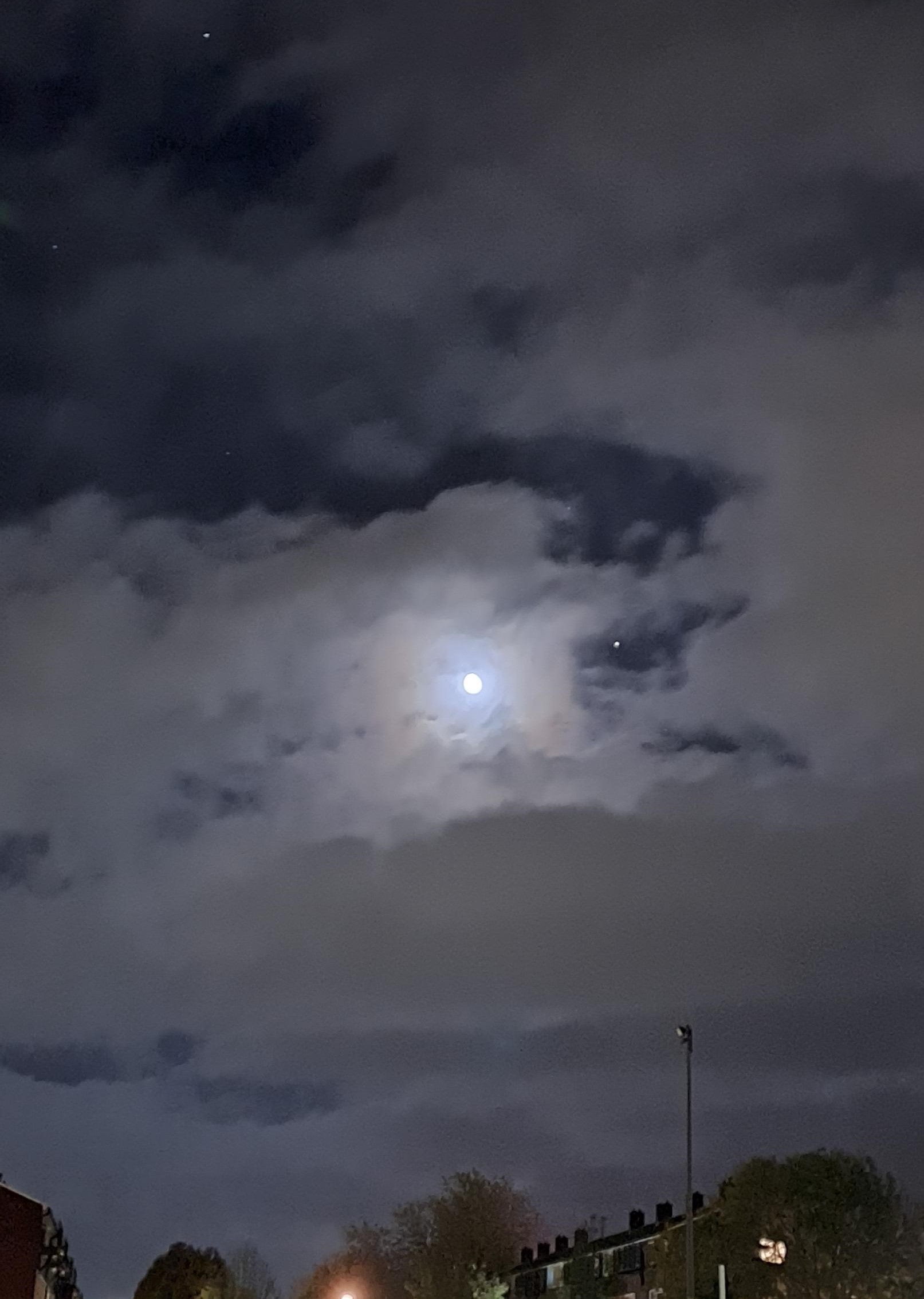
A suitably spacey photo...

I also divvy up sci-fi into science fiction and space fantasy (also occasionally called 'space opera'). This roughly follows the rules of 'hard' and 'soft' science fiction, although I'm not keen on those distinctions. They are dated and don't really capture the intersections of scientific progress.

The old rule used to be that 'hard' science-fiction bent or changed one rule of science, while in 'soft' science-fiction, pretty much anything goes. Keeping the former as science fiction, I'd describe space fantasy as advanced technologies separated by vast time periods from our present, or unconnected to current human history at all, like the Star Wars films being set 'a long time ago in a galaxy far, far away'. 

Here are some examples of books I've read in the four rough categories...

Alt-hist - changes details in the past to create a different set of events, or a different contemporary reality. The Plot Against America by Philip Roth explores how the USA could have adopted Nazi ideology in the 1930s. I'd also include Jasper Fforde's books about Thursday Next here and any other books about a world that looks a bit like ours but is different in some way.

Speculative fiction - starts (broadly) with where we are now and predicts what might happen in the future. This can drift towards science fiction when something novel is introduced (like triffids, for example) but the emphasis is always on the human side of things rather than the technology. Well known examples would be The Handmaid's Tale, or Nineteen Eighty-Four and Brave New World (in a previous generation). JG Ballard's books The Drowned World and The Drought fit more here rather than in science fiction.

Science fiction - stories that revolve around or focus on a particular discovery, advance in knowledge or change in technology. 2001: A Space Odyssey and I, Robot fit here because humans discover or introduce something that changes the world. I feel this is getting rarer as a genre in terms of new releases. However, the Expanse novel series is a good example of how this genre can still produce new compelling stories.

Space Fantasy - examples would be Dune by Frank Herbert, the Culture novels by Iain M Banks, novels set in the Warhammer 40,000 universe, and several of Alastair Reynolds's books. I enjoyed reading Adrian Tchaikovsky's books Children of Time and Children of Ruin, and both of those belong in this category. 

These are just my own categories and I'm probably inconsistent. But then I'm only classifying books for my own enjoyment, so it probably doesn't matter which category books end up in. 

Monday, November 07, 2022

Finally finished Farscape!

Yes, we have finally frelling finished Farscape! 23 years after I first watched most of the first season on BBC2, I can tick this series off. 

Sometime towards the end of last year, I was reminiscing about Farscape. Cathy bought me a copy of the DVD box set for Christmas. Unfortunately, it was on a region-specific DVD and we didn't have a multi-region DVD player. However, these days DVD players are old technology and we could buy a new multi-region DVD player at minimal cost.  So once that had arrived and we had set it up... we could start watching the show from the beginning of the first series again. 

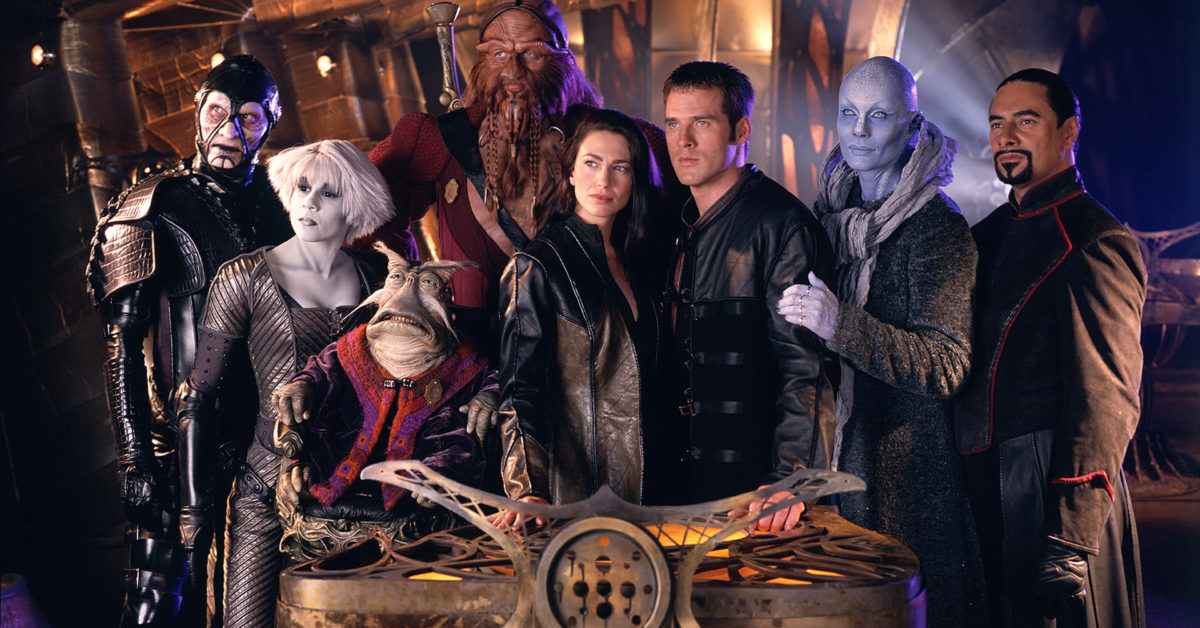
The basic premise of Farscape is an accident befalling an astronaut called John Crichton who is testing a new spaceship, the Farscape Module. The ship unexpectedly causes a wormhole in space, his ship passes through it, and then on the other side of the galaxy he meets a bunch of different aliens who have all similarly been uprooted from their lives. Thrown together, they gradually become his loyal friends. Well, loyal-ish. They often have their own agendas and aren't always trustworthy.  

One of the things I liked about Farscape when I first saw it was its use of puppet creations made by the Jim Henson Creature Shop. While they still had recognisably humanoid tendencies, including two front-facing eyes, noses and mouths in roughly human proportions, the diminutive Rygel and the hulking Pilot who was embedded into the living spaceship, Moya, both looked properly alien. The rest of Moya's alien inhabitants were all people in make up or latex masks as is pretty standard in science fiction series. The one exception is a very human looking character called Aeryn Sun, a female "Sebacean" who becomes the love interest for Crichton as the seasons progress. 

Personally, I felt the puppets still worked. However, there is also plenty of grainy CGI, which was ground-breaking in the late 90s and early noughties but looks distinctly dated now. The quality of each episode is variable. Some are tightly scripted and have a clear story arc. Others are looser in their approach and seem to have characters wandering around for no discernible reason other than to kill a few minutes of runtime. 

However, the show had some neat ideas. When Crichton first arrives on Moya he's immediately injected with "translator microbes" that explain how he can understand all the other aliens. The idea of a spaceship that is mainly organic and genetically engineered is still novel. The show also developed its own vocabulary of swear words. "Frel" was an obvious replacement for an English word beginning with f. There was also "dren" which roughly translated to crap, and "tralk" which correlated loosely with slut. 

The show managed to avoid being too cliched. There are quasi-fascist bad guys (the ironically named Peacekeepers) but that didn't drift into a rebellion versus empire scenario, and there are competing factions and races who are neither better nor worse options. There is also a spiritual element to the show, with an apostate priest called Zhaan as one of the main characters. Throughout the show there are hints of an afterlife and another plane of existence inhabited by the souls of the dead.

I'm not going to do a full plot summary, but the first two series have a lot more self-contained episodes, although the storylines are common to science-fiction series - there's a body-swap episode, an episode where a character gets marooned and ages in comparison to the rest of the shipmates, a planet where one of the characters is revered as a god, a planet where a character accidentally gets married and so on. Just about every science fiction series has some or all of these events occurring in some way. 

Midway through season two a definite story arc emerges. A new principle baddie, Scorpius, comes to the fore and he has a reason for relentlessly pursuing Crichton. The show also begins to focus more on Crichton's quest to get home. Seasons three and four explore this further, with Crichton having to decide whether he dare jeopardise the safety of Earth by returning. Season four ends on a cliff-hanger with Crichton and Aeryn turned into glass beads by an alien weapon. 

However, that was the last episode of the last season. The story could have been left on that very dark note, but two feature length TV movies - The Peacekeeper Wars - followed. These weren't included in the box-set but I was able to pick them up off eBay very cheaply before we got to the end of season 4, so we watched them straight after the season finished. 


I wasn't hugely impressed with the feature length episodes. There was some closure to the main story arc regarding accessing wormholes. However, the plot revolved around using a hidden race of aliens who could create some kind of aura that would make antagonists seek peaceful resolutions and that all just got a bit convoluted and contrived. Along the way one of the main characters died a heroic death which sadly felt a bit meaningless by the end of the film, given the way Crichton eventually forced all the warring races to back down and accept peace or be annihilated by a weaponised wormhole. 

However, overall, I'm glad I can now say I have watched the entire show. There were definitely some good stories, particularly in the first two series. Claudia Black, who played Aeryn Sun, captured the character of a Peacekeeper commando abandoned by her own kind magnificently and was probably the strongest and most interesting character across the entire run of the series. There was a lot of humour throughout as well and it was darkly amusing how every single plan went wrong in some way. Weirdly, that made it feel a lot more realistic than a science fiction TV show with rubber-mask aliens ever should!

Wednesday, June 29, 2022

Film review - Pixar go meta with Lightyear

I had goosebumps when I saw the first trailer for Lightyear, last year. It's the bit where David Bowie singing Starman kicks in that just gets me. Now, having seen the film, I have had some thoughts. 

This post contains a few spoilers below the video for the trailer, so maybe watch the trailer and then go off and do something else if you don't want to read any spoilers before seeing the film yourself. 


So, the headline meta stuff about this film is that it is meant to be the movie that inspired the Buzz Lightyear action figure who is one of the main stars of the original Toy Story film. In Toy Story, a little boy called Andy is given a Buzz Lightyear figure as a birthday present. In the Pixar universe, this is the film Andy saw in the cinema that made him so excited to get his own Buzz Lightyear.

As a way of extending a successful franchise without continuing an established storyline, this struck me as genius. It's as creative as anything in the movie and starts things off on a clever footing. It's also not really a kids' film - but it is the film for the people who were kids when Toy Story came out 25 years ago! 

The opening few scenes include Buzz exploring an alien planet and saying lines of dialogue that will be immediately recognisable to anyone who has watched the Toy Story several times. That cracked me up. The dialogue worked in the film even if you weren't aware that it was lifted practically verbatim from the first movie. But knowing how those phrases will be repeated in Andy's bedroom by action figure Buzz after Andy's birthday party just filled me with joy.

So, on to the story. Buzz causes an exploration spaceship to crash, marooning 1,200 people on a planet, without any hyperfuel to get home. He wants to make amends and starts repeatedly testing potential hyperfuel compounds, trying to find the one that would enable the ship to leave the planet. Unfortunately, when he tests the fuel by slingshotting around the nearest sun, he experiences time dilation, skipping forwards years compared to the people he leaves behind. Each time he returns a few hours older from a mission, everyone else has aged a few years. 

There's a thoughtful core to that idea, of someone so depserate to make amends for their mistake, they actually end up missing out on life. While his friends and colleagues find love and start families, and live happy, fulfilled lives, Buzz singlemindedly perseveres on his quest to redeem himself - a quest that nobody asks him to undertake. 

Driven by failure and guilt, Buzz doesn't share in his friends' big moments, as they celebrate births and graduations and anniversaries. And in a heartbreaking scene he misses saying goodbye to his best friend and supporter as he returns from a mission after she passes away from old age. I found the scene where he played her recorded goodbye message in her room that now lay empty very emotionally moving. 

That idea gave core meaning to the film, with the question of what really makes a person a hero. There is a grace in accepting the situation and making the best of it - in this case raising a family to be proud of while founding a functioning society on a new planet. 

Then, of course, Buzz lands after one final trip to find the colony city under siege from robots that all say the word "Zurg" and the adventure part of the story kicks in. Buzz and some new friends have to save the day in a way he never expected. 

So, in summary, this felt like Pixar have rediscovered a bit of their soul after a real mix of duds and delights lately. I realise I am one of the few people who really did not like Toy Story 4 and am on record as saying I never needed another Toy Story film. But this isn't a Toy Story film. It had something different to say and said it well, which leaves me feeling like I would be interested in seeing another Lightyear movie.

Tuesday, May 11, 2021

Wisdom from Firefly: losing and being right

I was sure I had blogged about this in the dim and distant past of this blog, but I couldn't find it anywhere when I was compiling posts for my page of cultural posts. So here we go...

Firefly was a short-lived TV show that has garnered almost legendary status among fans of TV science fiction series. It was cancelled midway through its first season, however the fan community has kept it going and there have been comics and board games and similar related media over the last 15 years or so. (Including action figures...)

Yes, I own this...

The set-up of Firefly is very much 'Wild West in space'. Humans fleeing a dying planet Earth have colonised several planets in a cluster of solar systems that makes interplanetary travel possible. Several of the planets are arranged in an Alliance, which favours the interests of the more populous and prosperous planets. However, some of the less well-off planets reject the control-grabs of the Alliance and ultimately this leads to a "War of Unification" between the Alliance and the Independent Planets, which the Alliance wins, setting up an authoritarian government and trying to impose laws on the newly "unified" planets.

Some of the main characters in Firefly fought for the Independent Planets. The soldiers wore long brown overcoats and were known as 'Browncoats' as a result. Malcolm Reynolds, known as Mal, is the captain of Serenity, a Firefly-class spaceship. He was a Browncoat and still wears his military coat on a day-to-day basis in his post-war career of transporting goods between planets (sometimes illegally).

At one point Mal is questioned about some shady dealings by a hostile Alliance Officer who asks him how it feels to have been on the wrong side in the war. Mal looks him squarely and says:

"May have been the losing side. Still not convinced it was the wrong one."

I've thought about that phrase a lot over the last few years. It particularly resonates when I think about the EU referendum and the subsequent chaos that has followed. I am still convinced that leaving the EU was an utterly terrible idea, for so many reasons, and I am convinced that a great many people were manipulated into voting to leave the EU by individuals who stood to gain from Brexit and were determined to do anything to get that result. 

I find the idea of accepting loss while still holding onto principles and beliefs is very encouraging. It's a good way of responding to setbacks. Losing doesn't mean we were wrong. 

We are already witnessing how Brexit is turning into precisely the damaging outcome that was routinely dismissed as fear-mongering during the campaign, and we are less than six months out of the EU. There is a lot more to come. I have a feeling I will be thinking of Mal Reynolds' reply quite a bit over the next few years.  

Wednesday, May 31, 2017

Guardians of the Galaxy Vol.2 - big theological questions in a comic book movie (Spoiler warning)

Back in 2014 Guardians of the Galaxy was an unexpected hit after being widely tipped to be the first Marvel movie to bomb. Cathy and I both loved it (it was my film of the year) and we have subsequently got into GotG in a big way. Toys, books, comics, and playing the Awesome Mix soundtrack album quite a bit. I've blogged about how I found one storyline from the comics particularly inspiring. There was also a possible religious-themed social commentary in the first film - it's no accident the villain is a religious fanatic.

A few weeks ago Guardians of the Galaxy Vol.2 came out. I was a bit worried whether it would be anywhere near as good as the first one. But I also had high hopes. I wasn't disappointed. The film was brilliant. But what I got was something much deeper than I expected. It is probably the movie that has asked the most interesting theological questions for a long time. Spoilers follow, so don't read on if you don't want any.

I love this promo image


The first film ends on a slight cliff-hanger. Peter Quill (Star-Lord) is told he is half human, and half something else. Yondu tells a subordinate that he's glad he didn't deliver Quill to his father. This film is about Star-Lord and his dad.

His dad turns out to be Ego, the embodiment of the consciousness of a living planet housing the physical form of a Celestial, an incredibly powerful ancient life-form. The incarnated version looks just like Kurt Russell. Ego turns up to usefully save the Guardians from an attacking fleet of spacecraft and then proceeds to invite some of the team to come and visit his planet. When he explains who or what he is, he is asked if he is a god, and Ego says 'Yes, but with a small g.'

Star-Lord is told he is most likely immortal, what with being the son of a god with a small g. And then Ego reveals his intentions. His billions of years of consciousness have convinced him that other life forms are mundane and disappointing and he intends to wipe them out, transforming the matter of the universe into his own self. Presumably to become a God with a BIG G.

However to do this, Ego needed more power - the power of two Celestials - and had therefore roamed the galaxy as his Kurt Russell incarnated self romancing all kinds of alien races to try and procreate another being with Celestial power. One of the beings he procreated with was Meredith Quill, Star-Lord's mother, and Star-Lord is the only one of Ego's children to contain the necessary Celestial essence. (The rest of his offspring are now a mound of skeletons in a cave.)

Ego offers Star-Lord the opportunity to join him in transforming the universe into God but first Star-Lord has a question about his mother. Did Ego really love her? Yes, Ego replied, but his mission to change the universe was more important. Then Ego drops a bombshell, saying he gave Meredith Quill the brain tumour that killed her. Star-Lord doesn't ask any more questions, he just draws his guns and begins blasting away at the Kurt Russell-shaped embodiment of Ego. Star-Lord and the Guardians then fight Ego, first to escape, and then to kill him.

As I said this is the most theologically interesting movie plot I've seen in a while. You could almost say it's an anti-theistic plot, in that it shows attacking a god (with a small g) as an heroic act. The Guardians get to save the galaxy for a second time. It's rare that a movie depicts deicide - the act of killing a god. Of course this isn't the 'god' of any established religion, this is a 'god' in a fictional setting, but it still opens up those questions.

Like many people who have been involved in a church a long time, I have prayed for people to be healed, who then haven't been healed. Just over 10 years ago a brilliant Christian man I knew died of cancer at the age of 32, a few months after diagnosis. This was despite regular prayer meetings, including at the Christian charity I worked at, asking for him to be healed. My experience is not unique. Prayers for healing often go unanswered.

I don't think it's an accidental music choice that when the Guardians arrive on Ego's planet, the song playing is George Harrison's 'My Sweet Lord' with it's refrain "I really want to see you, Lord." This is something prayed in earnest by many believers when praying for God to intervene in a situation.

If God doesn't intervene, Christians console themselves with reassuring statements that God's ways are higher, or there must be a plan behind it all, or, the line I hate most, that God takes the best ones first. (What does it say about those who don't die young?) Sometimes it's said that by dying, people are "really healed" as in made perfect in the afterlife. But that wasn't what was prayed for. When I have prayed for people I wanted them restored to full health in this life. And then sometimes people say that God will have all the answers when we see him after we die. That feels a bit 'too little too late' to me.

Guardians of the Galaxy Vol.2 actually gives its main hero the opportunity to ask those questions without having to die first. If Ego is so powerful why couldn't he save Star-Lord's mother? The answer is so callous and cruel - not only did Ego not prevent it, he actively caused it - that Star-Lord forgets all about the promise of his own immortality and proceeds to attack the being who fathered him.

If we did get answers to our questions and we didn't like them what would our reaction be? Would we suddenly turn on God like Star-Lord? That's a big question. All the assumptions are that when we get answers we will be satisfied by them, but what if we are not?

I discussed this with Paul Hammond, presenter of the morning show on UCB Radio last week and Paul asked whether comic book movies are the right place for these kind of theological topics to be explored. It was a question that surprised me a bit, but as I thought about it I realised that they are possibly the only movies left where they can be asked. There is a layer of cynicism running through most 'realistic' cinema these days so perhaps to discuss questions of belief you first have to get the audience to suspend disbelief. If you've accepted spaceships and pink slimy monsters and genetic experiments that look like talking raccoons, it's not a stretch to consider interacting with a divine being - even if it only a god with a small g.


Wednesday, March 01, 2017

2017 film reviews - January & February

This year I am going to try and review films througout the year rather than having a stupidly long list at the end of the year like I did in 2016. So, to start this off here's the list of films I saw for the first time in January and February 2017. The key is as follows: C = cinema, D = DVD, N = Netflix

The Secret of Kells (D) - made by the team who made Song of the Sea (which was my film of the year in 2015). Brendan, an apprentice manuscript artist working in the scriptorium in Kells monastery looks after a manuscript gospel begun by St Aiden on Iona, as Kells comes under attack from Vikings. He is helped in his mission to protect the book by a faerie called Aisling who lives in the forest outside the monastery. The animation is excellent, although not reaching the heights of Song of the Sea, and the story is well told.

Passengers (C) - big budget sci-fi starring Chris Pratt and Jennifer Lawrence, who are both 'passengers' who have paid a huge amount of money to travel to another planet. A few decades into their 190 year journey they wake up. It's hard not to write about this without spoiling it, but it raises interesting questions about being faced with your own inevitable mortality despite having the rest of your natural life to live and what would you do if circumstances trapped you in total isolation from the rest of humanity. The film had a few flaws, but both lead actors were very good and I enjoyed it.

A Monster Calls (C) - Cathy and I had both read the book by Patrick Ness that this is based on, so we knew what to expect. The story focuses on Conor, whose mother is dying from cancer. One night the yew tree in the neighbouring churchyard comes alive as a monster and offers Conor three tales, told in animated sequences, before demanding Conor tell him "the truth". It's not an easy subject to cover in a film but it tries to address the difficult mixed feelings people have in those horrible situations. We both thought it was very well done, but Cathy felt they had missed one of the key aspects of the book. I was a bit thrown to realise halfway through that I recognised Conor's dying mum, Lizzie, as Jyn Erso in Star Wars: Rogue One. Other actors involved include Sigourney Weaver, who gives an understated masterclass in acting as Conor's grandmother.


Ex Machina (D) - science fiction thoughtful thriller from British screenwriter and director Alex Garland. Domhnall Gleeson plays a programmer called Caleb who works for a search engine company and wins a staff lottery to spend a week with Nathan, the reclusive billionaire company founder, at his isolated luxury home. Nathan wants Caleb to run a Turing test on a possibly sentient artificial intelligence he has created. The AI looks feminine, is called Ava and is played brilliantly by Alice Vikander. Caleb starts to believe Ava is genuinely conscious and therefore alive and then has to decide if he will help free her from the secure area where Nathan has contained her. But Ava might have 'her' own plans. This is a thought-provoking film looking at some of the issues involved in creating articifial intelligence and I thought it was well worth a watch.

What's Your Number? (N) - rom-com with Anna Faris as a 30-something woman with a disastrous love life who gets hung up on the number of men she has slept with. Not wanting to bump the number higher she decides to revisit all her ex's in the hope that one of them has developed into marriageable material. She enlists her lothario neighbour, played by Chris Evans (AKA Captain America) to help her track them down and in the process rather predictably they end up liking each other. I did laugh quite a few times, particularly at the scenes involving Faris' real-life husband Chris Pratt who pops up here as one of her ex's. Chris Evans is also funny and very watchable. There's a bit of nudity and frank sex talk, but nothing over the top. Andy Samberg has a very brief cameo, which also made me laugh a lot.

The Cobbler (N) - Adam Sandler plays a New York cobbler who's inherited the family firm, including a load of old junk in the basement. Hidden down there is an ancient shoe repair machine with magical properties that means when he puts on the shoes he has repaired he takes on the likeness of the owners of the shoes. This sounds on paper like an awful premise, but it strangely worked, helped by a strong supporting turn from Steve Buscemi and a bit of a twist. Well worth watching for something a bit different.

Good Will Hunting (N) - I know, I know, it's 20 years old and people can't really believe I'd never seen it, but hey, I'm finally caught up. Surely everyone knows the story and the story behind the story - that Matt Damon and Ben Affleck wrote a script and ended up winning an Oscar. Everyone talks about Robin Williams in this, and he is great, but I feel for Stellan Skarsgard who never gets mentioned but is absolutely pivotal. It's weird watching this now, and remembering how fresh-faced Affleck and Damon once were, before fame and Bourne and Batman. They tend to sleepwalk through movies now so it was kind of nice to see them act. Also I think I appreciated the film more, having been to Bawstun and hearing the accents in real life and riding the train through the city.


Sing (C) - Animated film about a city full of animals where a koala puts on an X-Factor style competition to try and save his crumbling theatre. The 'we need to save the theatre' trope was a cliche when the Muppets re-used it for their comeback movie several years ago. So that wasn't promising. The characters are a mixed bag. None get explored in real depth. There's a happy-ish ending and one or two clever jokes, but nothing exceptional.

The Lego Batman Movie (C) - I've already written a (spoilery) blog about how this didn't really work. It will appeal to a lot of kids who like Batman and who like people being silly and will therefore like Batman being silly. They have a lot of fun with the Batman mythos, but as a film it isn't great. There are cameos from villains from other franchises as well.

Birdman (N) - There was some hype about this when it came out and it won an Oscar for Best Picture. Michael Keaton is great as an actor who was famous 20 years previously for portraying a masked vigilante superhero before such films were such big business, and is now trying to resurrect his career in a Broadway play. I do wonder exactly how much of his real life feelings of regret for walking out on Batman back in the mid-90s informed this movie. It's hard not to think Birdman is a bit close to the bone. The film is a bit slow. Some of the other characters are a bit annoying. I didn't really like the ending. But overall I thought it was worth a watch and the cinematography as characters are followed through the twisting backstage corridors of the theatre is fantastic.


Ratchett & Clank (N) - I'm not sure this actually got a cinema release. Certainly it didn't really register. Catching up on Netflix, it's a by the numbers kids science fiction animation based on the vintage PlayStation game(s). Ratchett is a mechanic who wants to join the Galaxy Rangers. Clank is his robot buddy (and is rather adorable). Together they thwart evil, including a villainous robot voiced by none other than Sylvester Stallone. It's enjoyable knockabout stuff which made me laugh along the way, but isn't really a must-see.