Yes, we have finally frelling finished Farscape! 23 years after I first watched most of the first season on BBC2, I can tick this series off.
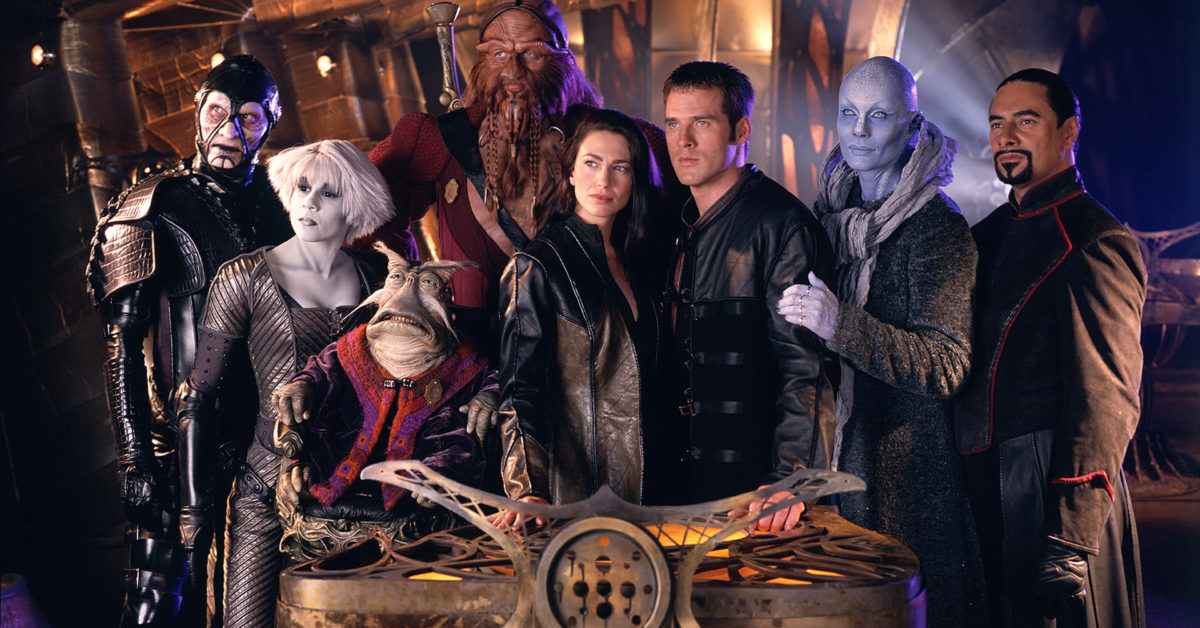
Sometime towards the end of last year, I was reminiscing about Farscape. Cathy bought me a copy of the DVD box set for Christmas. Unfortunately, it was on a region-specific DVD and we didn't have a multi-region DVD player. However, these days DVD players are old technology and we could buy a new multi-region DVD player at minimal cost. So once that had arrived and we had set it up... we could start watching the show from the beginning of the first series again.
The basic premise of Farscape is an accident befalling an astronaut called John Crichton who is testing a new spaceship, the Farscape Module. The ship unexpectedly causes a wormhole in space, his ship passes through it, and then on the other side of the galaxy he meets a bunch of different aliens who have all similarly been uprooted from their lives. Thrown together, they gradually become his loyal friends. Well, loyal-ish. They often have their own agendas and aren't always trustworthy.
One of the things I liked about Farscape when I first saw it was its use of puppet creations made by the Jim Henson Creature Shop. While they still had recognisably humanoid tendencies, including two front-facing eyes, noses and mouths in roughly human proportions, the diminutive Rygel and the hulking Pilot who was embedded into the living spaceship, Moya, both looked properly alien. The rest of Moya's alien inhabitants were all people in make up or latex masks as is pretty standard in science fiction series. The one exception is a very human looking character called Aeryn Sun, a female "Sebacean" who becomes the love interest for Crichton as the seasons progress.
Personally, I felt the puppets still worked. However, there is also plenty of grainy CGI, which was ground-breaking in the late 90s and early noughties but looks distinctly dated now. The quality of each episode is variable. Some are tightly scripted and have a clear story arc. Others are looser in their approach and seem to have characters wandering around for no discernible reason other than to kill a few minutes of runtime.
However, the show had some neat ideas. When Crichton first arrives on Moya he's immediately injected with "translator microbes" that explain how he can understand all the other aliens. The idea of a spaceship that is mainly organic and genetically engineered is still novel. The show also developed its own vocabulary of swear words. "Frel" was an obvious replacement for an English word beginning with f. There was also "dren" which roughly translated to crap, and "tralk" which correlated loosely with slut.
The show managed to avoid being too cliched. There are quasi-fascist bad guys (the ironically named Peacekeepers) but that didn't drift into a rebellion versus empire scenario, and there are competing factions and races who are neither better nor worse options. There is also a spiritual element to the show, with an apostate priest called Zhaan as one of the main characters. Throughout the show there are hints of an afterlife and another plane of existence inhabited by the souls of the dead.
I'm not going to do a full plot summary, but the first two series have a lot more self-contained episodes, although the storylines are common to science-fiction series - there's a body-swap episode, an episode where a character gets marooned and ages in comparison to the rest of the shipmates, a planet where one of the characters is revered as a god, a planet where a character accidentally gets married and so on. Just about every science fiction series has some or all of these events occurring in some way.
Midway through season two a definite story arc emerges. A new principle baddie, Scorpius, comes to the fore and he has a reason for relentlessly pursuing Crichton. The show also begins to focus more on Crichton's quest to get home. Seasons three and four explore this further, with Crichton having to decide whether he dare jeopardise the safety of Earth by returning. Season four ends on a cliff-hanger with Crichton and Aeryn turned into glass beads by an alien weapon.
However, that was the last episode of the last season. The story could have been left on that very dark note, but two feature length TV movies - The Peacekeeper Wars - followed. These weren't included in the box-set but I was able to pick them up off eBay very cheaply before we got to the end of season 4, so we watched them straight after the season finished.

I wasn't hugely impressed with the feature length episodes. There was some closure to the main story arc regarding accessing wormholes. However, the plot revolved around using a hidden race of aliens who could create some kind of aura that would make antagonists seek peaceful resolutions and that all just got a bit convoluted and contrived. Along the way one of the main characters died a heroic death which sadly felt a bit meaningless by the end of the film, given the way Crichton eventually forced all the warring races to back down and accept peace or be annihilated by a weaponised wormhole.
However, overall, I'm glad I can now say I have watched the entire show. There were definitely some good stories, particularly in the first two series. Claudia Black, who played Aeryn Sun, captured the character of a Peacekeeper commando abandoned by her own kind magnificently and was probably the strongest and most interesting character across the entire run of the series. There was a lot of humour throughout as well and it was darkly amusing how every single plan went wrong in some way. Weirdly, that made it feel a lot more realistic than a science fiction TV show with rubber-mask aliens ever should!


