Showing posts with label children's fiction. Show all posts

Monday, January 13, 2025

Book of the Month - Chronicles of a Lizard Nobody


This is a book aimed at teenagers, but when I saw it in my favourite local bookshop (Griffin Books in Penarth) I was attracted to the illustrations. The one on the back (below) really made me laugh. So I decided to buy it, justifying it by telling myself that it's worth checking in on books written for a different demographic sometimes. 

Something about this made me giggle in the shop

Chronicles of a Lizard Nobody is written by Patrick Ness, author of A Monster Calls, which I read years ago just before I watched the big screen adaptation (review of the movie included here). The illustrations, which are the main reason I decided I wanted the book, are by Tim Miller. The drawings inside aren't all as charming as the ones on the cover, however I enjoyed having a few pictures alongside the story.

The protagonist of the book is Zeke, the titular lizard nobody, who with his two lizard friends, attends a school full of other animals. They are the only lizards who go and even though they are monitor lizards it is JUST A COINCIDENCE that they are asked to be hall monitors in the school. This is communicated to them in ALL CAPS. But the lizards are sceptical. 

There is also a bully in the school, a pelican called Pelicarnassus, whose mother is a supervillain. Zeke also has a very odd affliction. the result of a family curse, to contend with. But this being a Patrick Ness story, the real struggle isn't with the son of a supervillain or the daft annoyance of the curse. There are in fact two other very big themes within the book.

Firstly, the lizards are from the poorer end of town and are therefore outsiders in the school. It's not laid on too thick, but there's a racialist element to the way the lizards aren't included by the majority. I felt that could springboard some interesting conversations with teenagers. 

The second big theme is dealing with loss and post-loss trauma. Zeke comes from a one-parent home following bereavement and his mother is overtaken by grief and depression. So Zeke has to deal with something he doesn't know how to deal with, and, honestly, it's heart-breaking. Similar to A Monster Calls, Patrick successfully captures the reality of living through a shit situation and aching for things to change, without caring if it's better or worse, just wanting something different. 

I wasn't really expecting that theme to come through so strongly. Like I said at the start, sometimes it's worth reading a book that's not aimed at you. It can still resonate. 

There was also an excellent piece of wisdom that I think will be helpful to anyone navigating social situations. Zeke has a confrontation where someone calls him fat. While unpleasant, he considers the following

"...anyone who made fun of someone else's appearance like that immediately lost the argument; if you called someone "fat", then that didn't say much about the so-called "fat" person, but it said a lot about you." (p.99)

I know that probably isn't going to take all the sting out of being made fun of for anyone, but it's still a very good principle to take on board. Later, in another encounter with a mean character, Zeke reflects that when they say things about you that are true, then, again, they aren't telling you anything you don't know, but they are revealing the kind of person they are. 

So, there was plenty packed in this short book aimed at people a lot younger than me. But I thoroughly enjoyed it. There's a hint there might be a sequel on the way at the end and I will be keeping a lizard-like beady eye out for that. 

Wednesday, August 14, 2024

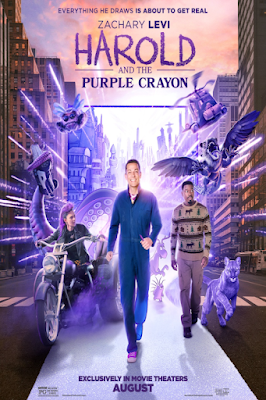
Film review: Harold and the Purple Crayon

SPOILER ALERT!


Harold and the Purple Crayon is a very popular illustrated children's book in America. Despite not being very familiar with the story, I thought the trailer for this looked interesting. And with Zachary Levi in the title role, it felt worth a look. 

The story starts with Harold and his friends, in their illustrated form, having various adventures with the magic purple crayon. Anything drawn using the crayon takes form, whether that's a dragon, a moose, a porcupine, a boat, or whatever. 

Harold and his friends are used to listening to the "narrator" and when the narrator stops answering their questions, Harold draws a way into the "real world" to try and find him. Mayhem ensues as Harold uses the creative power of his purple crayon to help people, although his good intentions cause chaos. 

I won't relate the entire story, but basically there are people who realise the power of the crayon and use it for their own ends, but it all works out in the long run. Zooey Deschanel plays the other lead role opposite Levi and there is able support from Lil Rey Howery (who I last saw as Buddy in Free Guy) as Moose, Tanya Reynolds as Porcupine, Benjamin Bottani as Harold's first friend in the real world, and Jermaine Clement (from Flight of the Conchords) who plays a great hammy villain. The script is quite tight - I laughed several times - and the runtime of 90 minutes is just the right length.

Apparently the reviews haven't been kind to the film, but what do film critics know, really? I went in with fairly low expectations and was pleasantly surprised. And there was one element of the film that went a bit deeper than I expected. 

Harold has entered the real world looking for the 'old man', the narrator. This is a mix of father figure and creator, who has suddenly gone silent. As he becomes aware of who the 'narrator' was - the author of the book, the late Crockett Johnson - he realises that from now on he won't have a narrator for his adventures. This places him in existential crisis - asking the big questions of what does he do with his life now?

In one sense this is a way of looking at parental bereavement. The gap left by a now absent parent. But, for me, it felt there was a wider parallel of any occasion where we are feel that things we were certain about are no longer certain and the need to find a way through - that suddenly we are the narrators of our own stories, the creators of our own worlds and we can't rely on there being a voice from the sky telling us what to do next. 

Harold's response when he gets a final message from the author, telling him to take his destiny into his own hands is to be grateful for the opportunity and to see it as an adventure. It is refreshing to watch a movie with such an uplifting and life-affirming conclusion. 

Monday, August 29, 2011

What was he daydreaming about?

Now it may just be me and my filthy mind, but this book seemed a bit inappropriate for kids...

Monday, August 06, 2007

Finnside Jokes?

I’ve been toying with the idea of writing a children’s book for some time, or at least that’s my excuse for reading kids books (but not Harry Potter and the Phnub Phnub Bleerr, or whatever it is).

Over the past year I’ve read four of the Moomintroll books, including a couple I hadn’t read as a kid. Maybe it’s just they haven’t aged well, or they’re in translation, but how weird are those books? It feels like you’re reading something in code.

The stories themselves are stream-of-consciousness narratives which don’t seem to follow any thought-out plan. But it’s the characters which feel most like an inside joke, with you the reader firmly on the outside of the humour circle.

There are several instances where it seems a character exists only to poke fun at someone Tove Jansson knew. The Muskrat, for instance, moans a lot and likes to think deep thoughts and not be disturbed. I imagine him as being a caricature of a cantankerous, bearded uncle.

In my minds eye I can picture Jansson reading out her stories in family gatherings with everyone collapsing in fits of laughter when the philatelist Hemulen starts going on about his precious stamps, or the Snork Maiden almost falls over a cliff because she’s primping her hair, or whatever. It’s funny when you don’t know the people she’s sending up. It must have been downright hilarious if you did.

In Comet in Moominland, Moominpappa’s obsession with recording his life in his journal – to the point where he feels he has to go out and do something so he’s got something to write about – reminds me a bit of my own dad, ringing me up to check how many football matches I’ve been to last season (and where). Maybe it’s a common trait of dads. Certainly, I’m willing to bet the loving, resourceful, wise, distracted Moominpappa, and the knowledgeable, caring, permission-giving Moominmamma are basically Jansson’s mum and dad in (moomin)troll-suits. (And the thought occurs that Moominpappa would have made an interesting blogger.)

So where is the author in all these trollish happenstances? Is she the boyish hero Moomintroll, or his noisy, messy, small chum Sniff? Or is she the cool and detached Snufkin, watching and going along with the plans of Moomintroll? It seems everyone else she knows is in there somewhere. She must be in there too.