Showing posts with label smoking. Show all posts

Sunday, March 20, 2022

Picking up litter on a bright sunny day

The weather this past weekend has been glorious. I got roasted watching a football match on Saturday and on Sunday joined the Keep Grangetown Tidy monthly litter pick. As ever, I am going to blog about some of the more interesting stuff I found. I started out well with a shiny £1 coin!

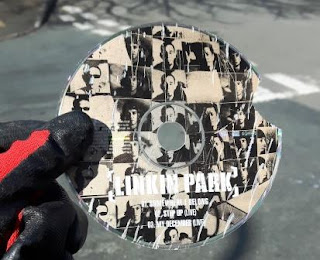
Then I got a jolt of nostalgia. Remember when bands used to issue CD singles with bonus tracks like live recordings? Well, this is unplayable now, but it's a throwback to life before streaming.


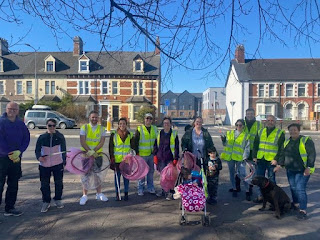
We had a visitor from Wales Online for the litter pick. I don't know if this photo that I grabbed off the Keep Grangetown Tidy socials will be on the website or not.


One other person came prepared for sunshine and wore sunglasses. The journalist disappeared before I could offer some opinions and observations on litter picking. 

One of the main things I've noticed has changed since I first went on a litter-pick is the amount of pandemic-related litter. I picked up eight facemasks, two empty hand santiser bottles, two disposable gloves (in different streets - not a pair together), and one of the solution dropper things from a lateral flow kit. This is all garbage that wouldn't have been part of a litter pick three years ago!

Another observation is that smokers who switch to vaping are still inclined to discard items relating to their addiction in the street. I lost track of how many empty boxes of vape juice I picked up. This observation has informed my opinion that smokers are inherently dirty people. Because even if they switch to a less damaging means of self-poisoning, they still don't clear up their smoker's trash. 

Anyway, on with the "finds".

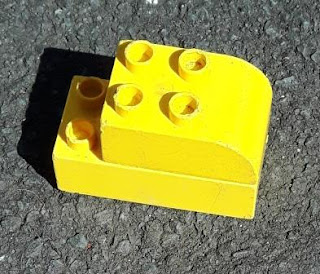
I do have some "found Lego" in my Lego stash. However, this Duplo went in the bin bag.


It amused me that this glass still had a straw in it. Were they really drinking Carling through a straw?


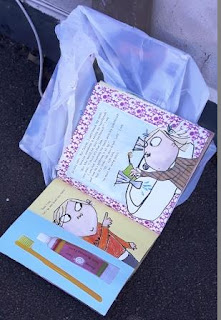
Someone had decided to start an impromptu street library. Unfortunately the books in the plastic bag had got wet and ruined. Charlie and Lola ended up in the bin bag too.


And this also got chucked. I have no idea what it is. 


Another weird thing was a frying pan in a carrier bag. I found a security tag like the kind you get on clothing. There was McDonald's trash with the Deliveroo stickers stuck on the hamburger boxes. I also found evidence that people buy and consume those awful-looking Weetabix drinks because I picked up an empty bottle that someone had chucked over a gate when they had finished chugging it. 

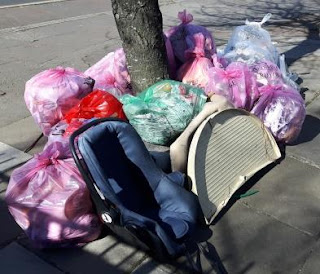
All that trash ended up in the pile of rubbish at the end. This picture wasn't the final heap of stuff but it gives an idea of how discarded items and rubbish mounts up when it's gathered altogether. 


Lots of people said thank you as I was walking around collecting rubbish. More people say thank you than actually pick up a grabber and join in. But at least they see people taking action to tackle the problem and maybe that will encourage more people to act that way. 

(And I kept the £1 coin!) 

Thursday, December 29, 2011

Political blog post: unemployment

One of the unexpected side-effects of working in a job tangentially linked to public health is that I keep discovering new things. I’ve become a gatherer of noteworthy trivia and factoids that actually scare me when I think about them.

One of the more shocking was this: chronic worklessness has an equivalent debilitating effect on a person’s health as smoking 20 cigarettes a day. That means that if someone is unemployed for a long period of time, they are statistically more likely to die at a younger age than someone with a job – to the same tune as if they puffed a packet of death-sticks every 24 hours.

We know the effects of smoking, and most sensible people would support a total ban if any government had the balls to do it. Lung cancer is a truly horrible way to die. I've seen it kill someone I care about, so I know that. But we don’t see the wasting disease of the soul that is unemployment in quite the same way – its impact is hidden.

And yet draw a map of disease and early mortality in any part of the country and the map will always follow a pattern: low mortality = poverty = high smoking = high obesity (i.e. poor nutrition) = low child birth weight = chronic or prolonged unemployment = poor housing = higher cancer rates, more heart diseases, more illness per se.

Poverty and suffering from ill health go hand in hand on any public health map drawn up ever.

And poverty and worklessness go hand in hand on any demographic map drawn up ever.

Just before Christmas the Government announced it was going to put over £400m into efforts to tackle ‘problem families’ – i.e. dysfunctional families with ‘feckless’ dads, tearaway teens, benefits cheats and criminal genes. This wasn’t new news, but it was reported as such. The Government previously said it was going to spend over £300m in October. Inflation means everything costs more a few months later.

A Daily Mail article that ran in October carried the headline “How Britain's Shameless families cost the taxpayer £8bn every year.”

It went on to say:
“The summer riots have convinced the government that drastic steps are required to tackle a hardcore of workless neighbourhoods where no-one has a proper job.

The coalition says Labour’s welfare legacy means there are many parts of Britain where three generations of families have never worked and live a life funded by state benefits.

Some neighbourhoods, particularly in inner cities and on large estates, are so blighted by long-term unemployment that no-one on a street has a job and children never see anyone getting up and going to work.”
We have a scenario, then, where generations of young people are growing up in workless households, where to be unemployed is the norm. There’s a reason for that. Good jobs – and by that I mean jobs that will enable you to pay the rent or mortgage, buy nourishing, nutritional food, pay for insurance, pay for heating and lighting, clothe your kids and yourself, and maybe have enough left over to pay for a monthly night out at the cinema – are hard to come by.

Whose fault is that, exactly?

According to Government, and reproduced faithfully by the bleating Mail, Labour’s welfare policies are responsible for “three generations of workless families”.

I know it feels like forever since Tony Blair’s New Labour victory in 1997, but that wasn’t three generations ago. It must be linked to whoever was in charge before Tony.

And what is Labour’s record when it comes to employment, anyway? One of the sea-changes in British politics came after the Second World War. The newly-installed Labour Government is still, I think, the only British Government ever to state a commitment to full employment. There would be jobs for people as Britain rebuilt itself – that was the plan.

It was ambitious, but it wasn’t a pipe-dream. It was founded on an ethic that saw the social good in employment. Work wasn’t just about earning money – or even a cynical exercise in keeping the population occupied. Work was something that drew communities together. If the majority of people in a community work in local business or manufacturing, it creates cohesion. Never mind the individual health benefits that we now know accrue from being engaged in work.

Another sea-change was the Thatcherite revolution of the 1980s. The privatisation of national industries – gas, telecoms, electric – were all justified using economic arguments. Nationalised industries were inefficient, they had too many employees, they were monopolies that kept prices high.

So they closed the pits and the steelworks, the mills and the mines.

Interesting story – when my Dad was 16, my Granddad had a word with a friend and got my Dad a job at the steel mill that loomed above the small Welsh village where he grew up. Dad had other ideas – he wanted to study medicine and become a doctor, but many of his contemporaries went to work there.

In many respects, Dad chose a hard path. Studying medicine was even more brutal in the 60s than it is today – and I know enough junior doctors to know it’s pretty brutal today. He worked long hours, and later in hospitals and as a GP worked all hours of the day and night caring for people.

But he wasn’t thrown on the scrapheap when the steelworks was shut down in the name of efficiency in the late 1980s. He wasn’t forced, like so many people in their late 40s, to retrain for a new career and cross your fingers there would be work at the end of it. Being a doctor was a stressful career choice, no doubt about it. But he wouldn’t have traded places with the people facing an uncertain future before a retirement in penury.

That’s the thing about ‘efficiency’ – it’s only a benefit in the short-term to the balance sheet of the company. In the long-term, and we’re talking the inter-generational long-term, the social efficiency of keeping ‘inefficient’ industries going is far greater.

So, now the Tories are irked that billions are being spent on benefits for workless communities. Well, you reap what you sow.

Of course, the middle class tax-payers who senselessly vote Tory and equally senselessly read the Daily Mail are regularly up in arms about the work-deprived communities their taxes now subsidise. But Tory policy created those areas blighted by unemployment. Here’s an idea: Stop voting for the short-term, slash-and-burn, quick-buck opportunists.

The history of Tory economic policy is about short-sightedly sacrificing social capital and infrastructure for a few pence. There was never a golden egg they weren’t willing to kill the goose for. As a frivolous example, in the 60s they axed hundreds of picturesque railway routes throughout Britain, never thinking that one day heritage railways could potentially be money-spinners. (The Severn Valley railway once ran through the Ironbridge Gorge into the heart of Shrewsbury – think what that would be like as a tourist attraction now!)

When you are blinkered by the balance sheet you only see the money you will ‘save’, not the opportunities you will miss out on.

That was the 60s. In the 80s they hammered heavy industry – creating poverty blackspots that have drained the public purse for decades in the process.

What are they doing now? Youth unemployment is heading towards an all-time high. Incidentally, so are domestic fuel bills – ending those monopolistic nationalised industries certainly didn’t work in the consumers favour. The NHS is in a process of privatisation; with plans to corral off half of NHS beds for paying customers.

We’re told the NHS, like so much else, has to change because it is ‘inefficient’. But there are different ways of defining 'efficiency'. The NHS is actually very efficient at delivering a central element of what makes a society civilised – care at the point of need for all members of society, regardless of their economic status.

That principle is a bottom line worth more than any balanced books will ever be.
Wednesday, June 13, 2007

Published

Third Way arrived today and I’ve got a letter published in it. What I’m most chuffed about is that it’s right in the middle of the letters page with my name in big bold type. OK, I know it’s only a letter, but it’s still nice to know I can write coherently enough for an editor to choose my letter from the hundreds/thousands/tens they receive every month.

Background: Last issue they introduced Claire Fox from the Revolutionary Communist Party (relevant political mover and shaker, obviously, what with communism's implosion nearly 20 years ago) who blathered on a bit about how she became a communist and why she was anti-anti-apartheid. But the cover picture showed her striking a pose with a cigarette which irresistibly reminded me of when I was 17 and my friends joined the SWP, ANL or whatever, and smoked as a sign of their rebellion against society. I always felt smoking was a particularly stupid part of the posturing then, and I still feel that way now.

Cue my letter:

Nice to see that Claire Fox is still a rebel at heart. Why else would she strike a 'look at me, I'm so cool and rebellious I smoke!" pose on the cover of Third Way.
It's hard to respect a revolutionary communist who's also a nicotine slave, and through her addiction funds global capitalism while being the consumer at the end of a long chain of third world oppression. But then, maybe by smoking she's being anti-anti-capitalist. Or something.


I guess being sarcastic about their interview subjects is the way to go if I want to get my name in print more often!

Sunday, February 04, 2007

When stunts go bad

Saturday night and Irony Boy and I are flicking through the cable channels doing the three second judgment call on the dross that was on. That was until we started watching ‘When Stunts Go Bad’, car crash TV at its finest.

I think my favourite bit was when two Russian pilots in a flight display team crashed their Migs into each other. Both ejected safely, even though one plane was ripped in half and turned into a fireball before cratering the tarmac.

But then, the defining moment. One of the pilots has landed safely, his parachute billowing around him. As he lands he already has a cigarette between his lips. He steadies himself and steps out of the harness, lights up, shrugs his shoulders at the camera and saunters off as if that sort of thing happens every day.

No comment for the camera. No smile. Just a nonchalant drag of nicotine and a shrug. How cool is that cat?

After When Stunts Go Bad we teamed up for a co-op game of Halo2 and I found out that using two joysticks at the same time is as confusing as hell.

Thursday, September 07, 2006

Million dollar ideas

Every so often I get a brainwave for something that would be a ‘million dollar idea’. Recently Irony Boy has been the recipient of frantic emails from me outlining a potential million dollar website – ideas that are usually swiftly rebuffed by the self-appointed Web Tyrant.

Anyway, the other day I had a brilliant idea. In my office the one smoker in the building often nips out the back door for an ‘oxygen break’. Unfortunately this means that his pungent cigarette smoke wafts up through our second floor windows, which are always open because we have no air-con and the office is always way too hot. The other day, when the second hand smoke was being particularly annoying I joked that I was going to bring in a super-soaker water pistol to douse the source of the toxic fumes, and that’s when I had my idea:

Million dollar idea #1: The Smoker Soaker
This would be a small, concealable, but highly accurate, water pistol that you could use to squirt people smoking in annoying places, like restaurants or cinemas. For added irony, they’d come in a variety of colours, all of which looked a bit like cigarette packets, e.g. red/white, gold, purple, white with a royal blue stripe. That would make them collectible as well.

Million dollar idea #2: The Car Trainsporter
I don’t know why we don’t have roll-on, roll-off car-carrying trains in this country. It would make a lot of sense to me to be able to drive onto a train in Cardiff, then have a nice relaxing train ride up to Newcastle, drive off and have all the convenience of having my car with me and none of the six-hour cross-country slog.

I’d envision this working with car-loading points in big cities, away from current stations, as usually there are loads of redundant minor stations in areas ripe for redevelopment (or even using stations just outside big cities but which are right on the motorway). The trains, of course, wouldn’t need to stop in itty-bitty places and because you’d have your car with you, it would be fine if say the nearest car-loading point was fifty miles away from your home, and your exit point was fifty miles away from your eventual destination.

The pros of car-trainsporters:
Not having to drive on Britain’s hellish motorways for hours and hours and hours.
More environmentally friendly than air travel
No check in palaver – again better than air travel
Saves on petrol and wear and tear on the car – lower mileages mean lower insurance premiums; no chance of breaking down on the way
The trains could have buffet/restaurant cars, newsagents etc – this would also be a pro from the point of view of the train operator because they’d virtually have a captive audience
Much quicker journey times, although that is dependent on the reliability of the rail system. Hmmm.

The cons of car-trainsporters
Britain’s railway system sucks and it’s getting worse
Rail travel is already expensive – this wouldn’t be cheap
It can be pretty boring sitting in a car or sitting on a train, so how boring will it be sitting in a car while on a train?
It would take time to load up and unload
New car-loading stations would need to be built, and possibly new motorway junctions

But even so, it’s a million dollar idea. Feel free to use it…