Showing posts with label the Bible. Show all posts

Wednesday, January 25, 2023

An unexpected return to the ACCA

Just when everyone, including me, assumed the Annual Christmas Card Audit was over for another year, my Mum surprised me by giving me a bag full of all her Christmas cards to look through. It included this one that features the Old Market Hall in The Square in Shrewsbury, which I thought was apt to include given that's where Mum lives and where all this sample of cards came from.


I’m not going to do a full audit of Mum's cards, but I am going to use the bundle of cards to increase the size of the data sample in my quest to find the most popular Bible verse to feature on Christmas cards.

There were 71 cards in the bag my Mum gave me. 10 cards had Bible verses, which is about about 14% of the cards. That’s a much higher ratio of cards with Bible verses than in the cards that Cathy and I received this year (which you can read about here).

Unlike the cards with Bible verses on that cathy and I received this year, there were a couple of lines from the Nativity stories in the gospels included in Mum’s cards. But conversely, there were also no verses from the Psalms in Mum’s selection, unlike on the cards that Cathy and I received.

In order of appearance in the Bible, these are the verses. Isaiah was popular, particularly chapter 9, verse 6 which appeared on two cards, with different bits of the verse selected for inclusion.

Isaiah 9.6 “For to us a child is born, a Son is given.”

Isaiah 9.6b “His name will be called Wonderful Counsellor, Mighty God, Everlasting Father, Prince of Peace.”

That first bit featured on a card we received this year too!

There was a verse from later on in Isaiah as well.

Isaiah 60.1 “Arise shine, for your light has come, and the Glory of the LORD rises upon you.”

Moving into the New Testament, three of the four gospels were represented by a verse each.

Matthew 2.1 “After Jesus was born in Bethlehem in Judea, during the time of King Herod, Magi from the east came to Jerusalem and asked ‘Where is the one who has been born King of the Jews? We saw his star in the east and have come to worship him.’” (Perhaps unsurprisingly, this was on a card featuring the three wise men.)

Luke 2.14 “Glory to God in the highest, on earth peace, goodwill toward men.”

John 1.14 “The Word became flesh, and lived among us. We saw his glory, such glory as of the one and only Son of the Father, full of grace and truth.”

I’ve written essays on the prologue of the gospel of John twice in my life – when I was doing Religious Studies at A Level and then when I was doing my New Testament Studies module on my theology degree. I’d go on a limb and say it’s probably the most intriguing part of the New Testament. Previously another verse from this section of John’s gospel has featured on cards but this is the first time verse 14 has been counted.

And then we finish up with some verses from the random tiny books towards the end of the New Testament. None of these verses had featured previously in these audits. 

Titus 2.11 “For the grace of God that brings salvation has appeared to all men.”

1 John 4.9 “By this God’s love was revealed to us, that God has sent his one and only Son into the world that we might live through him.”

Jude 1.2 – “I pray that God will greatly bless you with kindness, peace and love!” – this appeared in 2 cards in Mum’s bundle, having never appeared in cards we have received. Both cards were the same design, from the same charity (The Leprosy Mission) so I’m only counting it once for audit purposes.

So, the new revised totals of verses on cards are as follows:

  1. Luke 2.11 (sometimes with a bit of Luke 2.10 attached) – 5
  2. Isaiah 9.6 - 4
  3. Psalm 33.21 - 3
  4. John 1.9 - 2
  5. Psalm 46.10; Psalm 139.11-12; Isaiah 40.5; Isaiah 60.1; Matthew 2.1;  Matthew 2.11; Luke 2.4-5; Luke 2.7; Luke 2.14; John 1.14; John 8.12; 2 Corinthians 9.15; Titus 2.11; 1 John 1.5; 1 John 4.9; Jude 1.2- all with 1

The big winner after counting this sample is Isaiah 9.6, which moves into second place in the table, leapfrogging Psalm 33.21. I was surprised that all the other Bible verses were brand new to the audit sample!

Tuesday, January 17, 2023

ACCA 2022 - Bible verse update

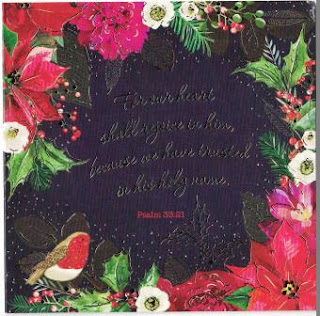
During a couple of previous audits I've noted which Bible verses feature on Christmas cards when I do my Annual Christmas Card Audit (ACCA). This is more to satisfy my own curiosity than anything else. This year, four cards featured Bible verses, including the one on this card that was printed on the front and inside!


I only count this verse once in my list, even though it appears twice on the card, because I'm just counting the cards.

For reference, because I realise not everyone knows this, the Bible is split up into a number of "books", each book is split into chapters, and each chapter is split into verses. This is to aid the reader to find a particular paragraph or sentence. Sometimes the names of books are shortened as happens on this card. "2 Cor" is short for 2 Corinthians, which is the second "book" called Corinthians. 2 Cor 9.15 means the quote is from chapter 9 and verse 15. The word NET refers to the translation of the Bible the quote has been taken from. I haven't bothered logging which versions of the Bible are most quoted. That feels too nerdy even for me!

Two of the four Bible verses that featured this year were ones I hadn't logged on cards before. In order of where they appear in the Bible, the verses were:

  • Psalm 33.21 – For our heart shall rejoice in him, because we have trusted in his holy name.
  • Isaiah 9.6 – For unto us a child is born, unto us a son is given. 
  • Isaiah 40.5 – And the glory of the Lord shall be revealed, and all flesh shall see it together; for the mouth of the Lord hath spoken it. (This was new)
  • 2 Corinthians 9.15 – Thanks be to God for his indescribable gift. (As pictured above - a new verse and the only one to appear on the front of a card!)

Chapter 40 marks the start of the third distinct section of the book of Isaiah, which is is a big book in the Old Testament. The third section is often described as the 'messianic' section (following the 'prophetic' chapters 1-35 and the 'historic' chapters 36-39). Some of the verses get borrowed in the gospels to describe Jesus, although Isaiah 40:5 was an unusual choice for a Christmas card because the verses around it aren't particularly focused on the Messiah.

I also thought it was a bit strange that this year there weren't any Bible verses taken from any of the gospels, where the stories of Jesus's birth appear. However, with five appearances in previous years, Luke 2.11 is still the most popular Bible verse to feature on a Christmas card (in my data sample). 

In order of popularity the verses are:

  1. Luke 2.11 (sometimes with a bit of Luke 2.10 attached) - 5
  2. Psalm 33.21 - 3
  3. Isaiah 9.6; John 1.9 - 2
  4. Psalm 46.10; Psalm 139.11-12; Isaiah 40.5 ; Matthew 2.11; Luke 2.4-5; Luke 2.7; John 8.12; 2 Corinthians 9.15; 1 John 1.5 - all with 1
This is very likely my final post related to the ACCA for this year. I haven't decided yet whether to continue doing it next year but I have had lots of positive comments which has encouraged me to consider carrying on.

Thursday, January 13, 2022

Bible verses on Christmas cards, 2021 edition

A few years back I did a little analysis of the most popular Bible verses on Christmas cards. I revisited it this year as part of the ACCA.

Overall there were seven cards that included a Bible verse. The only one with a Bible verse on the front was this one.


The gold foil is hard to read, so here it is: "For our heart shall rejoice in him, because we have trusted in his holy name" - Psalm 33, verse 21.

I looked that Psalm up. It looks like a song of praise that would have been sung in the Jewish Temple long before Jesus came along. It's not particularly messianic or prophetic in tone. The verse is repeated inside the card and they give the version of the Bible - the KJV (King James Version).

This verse featured on another card too, and overall Psalms was the most represented book of the Bible on the Christmas cards we received, with three cards featuring a verse. The other reference was Psalm 46, verse 10. 

There were two different verses from Luke and two different verses from John as well. The verses from Luke were different bits of the nativity story - chapter 2, verse 7, and chapter 2, verse 11. John doesn't have a nativity story. One of the verses  quoted was from the opening mystical 'prologue' about the Word of God becoming a human being - chapter 1, verse 9. The other was from later in the gospel, when Jesus says he is the light of the world in chapter 8, verse 12. 

When I did my previous analysis, Luke chapter 2, verse 11 was the most quoted Bible verse by a considerable margin, appearing on 4 cards. John chapter 1, verse 9 was also on a card in the previous analysis. The other Bible references are all new.

So the combined totals, based on when they appear in the Bible would be as follows:

Psalm 33.21 x 2
Psalm 46.10
Psalm 139.11-12
Isaiah 9.6
Matthew 2.11
Luke 2.4-5
Luke 2.7
Luke 2.11 x 5 (sometimes with a bit of Luke 2.10 attached)
John 1.9 x 2
John 8.12
1 John 1.5

With my old theology hat on, I find it interesting how disproportionately popular quotes from Luke's nativity story are compared to quotes from the gospel of Matthew. This is especially true when comparing card designs. I categorise 'nativity' cards as any cards that centre on Mary, Jesus and Joseph, regardless whether they also feature shepherds and kings (or magi, or wise men, or whatever term is vogue - you know who I mean). I only count the shepherds and kings in their own right if they feature on a card on their own. 

Overall, the kings are much more popular characters in terms of getting their own cards than the shepherds. But the kings feature in Matthew's stories and aren't in Luke's stories at all, while the shepherds are mentioned in Luke's stories - after they see the choirs of angels in the heavens while watching their flocks by night - but don't get mentioned in Matthew's accounts. 

So it feels like Matthew has the more interesting characters to depict on a Christmas card, but Luke has the quotable chunks to sum up the story.

And then we have John's gospel, that doesn't have any nativity stories at all, but is three times more popular in terms of quotes than Matthew's gospel, across this sample. There is very little comparison between John and the other gospels in terms of which one is the better gospel to read, but considering John has nothing of the Christmas story in it, this is weird. 

A conclusion might be that people prefer a good turn of phrase and don't really mind where it comes from. 

Wednesday, January 20, 2016

The final post about our Christmas cards: Which Bible verse is the most Christmassy?

Having done my annual audit, posted 10 of my favourite cards and then done a second, longer, post about who sends what kind of card, this, I promise is the last post on my blog about Christmas cards.

In my previous post about them I logged the kind of messages that appear on the front of the cards, including Bible verses. This then got me thinking about Bible verses that are used on Christmas cards, generally and I began to wonder what would be the most popular. I also realised there were no religious designs in the Christmas cards I posted before. so I have rectified this and included some designs in this post...

I really liked this one

I expected the early chapters of Matthew and Luke to feature heavily, as these are where the nativity stories appear in the gospels. The 'story' most people know from school plays and Christmas church services is actually a mish-mash of the two nativity stories in Matthew and Luke, which are actually very different to each other. On freelance theology I've written how the reason they are so different is because they aren't historical stories, but theological stories instead - they are written to make certain points about Jesus. [Read the article here.] I think that's probably why the stories are so different.

Dozing donkey and curious sheep

Given that the wise men / kings / astrologers / magicians appear in Matthew's story and not Luke's, while the shepherds feature in Luke's story and not Matthew's, and that we had 11 cards featuring the three kings and absolutely zero cards featuring the shepherds, I thought we were much more likely to see verses from Matthew appearing on the cards. Turns out, I was wrong.

In total we had 10 cards featuring Bible verses, which is about ten per cent of all the cards we were sent (working from a sample of 103).

The verses featured were, as follows:

Psalm 139.11-12
If I say, ‘Surely the darkness will hide me
    and the light become night around me,’
    even the darkness will not be dark to you;
    the night will shine like the day,
    for darkness is as light to you.

(I have no idea why that is considered Christmassy, but there you go. Strangely, this appeared on a card featuring an owl, and wasn't religious-looking at all. Although, I guess owls are birds of pray, har har har.)

This is the 'owl' card with a Bible verse in

Isaiah 9.6
For to us a child is born,
    to us a son is given,
    and the government will be on his shoulders.
And he will be called
    Wonderful Counsellor, Mighty God,
    Everlasting Father, Prince of Peace.

(An Old Testament prophecy that Christians believe is about Jesus.)

Matthew 2.11
On coming to the house, they saw the child with his mother Mary, and they bowed down and worshipped him. Then they opened their treasures and presented him with gifts of gold, frankincense and myrrh.

(This is part of the story of the three wise men, or 'three kings'. It was on one of the cards featuring the three wise men, but only one.)

One of the Kings was ginger...

Luke 2.4-5
So Joseph also went up from the town of Nazareth in Galilee to Judea, to Bethlehem the town of David, because he belonged to the house and line of David. He went there to register with Mary, who was pledged to be married to him and was expecting a child.

(As heard in every school nativity play, ever.)

John 1.9
The true light that gives light to everyone was coming into the world.

(Fun fact: the Gospel of John doesn't have any nativity stories. But it does have a "Prologue", which is probably the most linguistically sophisticated, theologically complicated and semi-mystical part of the whole New Testament. It may also be borrowed from pre-existing Gnostic traditions; it certainly draws on them.)

1 John 1.5b
God is light; in him there is no darkness at all.

(1 John is a short book towards the end of the New Testament that is traditionally ascribed to the same author as the Gospel of John. It's actually a letter, or 'epistle', sent to a Christian community by someone in authority. It shares a lot of common language with the gospel, including using the word 'light' a lot. The 'b' in the Bible reference indicates they only used the second half of the verse.)

More inquisitive sheep

And the most common Bible verse on Christmas cards, appearing on four of them waaaaaaas (drumroll...)

Luke 2.11
Today in the town of David a Saviour has been born to you; he is the Messiah, the Lord.

Although two of these were printed in ye olde worlde King James Version:
For unto you is born this day in the city of David a Saviour, which is Christ the Lord.

And one of the cards quoted verse 10 as well, but then edited both verses to come up with their own version, really:
Great tidings of great joy which will be to all people!. For there is born... a Saviour who is Christ, the Lord.

Meh, close enough.

This verse even appeared on one card in English and Welsh (where Luke is Luc):
Ganwyd i chwi heddiw yn nhref Dafydd, Waredwr, yr hwn yw'r Meseia, yr Argkwydd.

So, there you go, Luke 2.11 is apparently the most Christmassy Bible verse in the whole Bible. At least according to the people who make Christmas cards.

Previous posts

Annual audits: 2015, 2014, 2013, 2012

Friday, January 08, 2016

Interim bookey post - an extract from Burmese Days by George Orwell

The other reviews are coming soon. In the meantime, I've finished my first book for 2016: Burmese Days by George Orwell. It's a novel set in Burma during the British Empire. This bit amused me highly.

An hour passed, and a melancholy, earth-coloured Indian loitered up the drive, dressed in a loin-cloth and a salmon-pink pagri on which a washing-basket was balanced. He laid down his basket and salaamed to Flory. 
‘Who are you?’ 
‘Book-wallah, sahib.’ 
The book-wallah was an itinerant peddler of books who wandered from station to station throughout Upper Burma. His system of exchange was that for any book in his bundle you gave him four annas, and any other book. Not quite any book, however, for the book-wallah, though analphabetic, had learned to recognize and refuse a Bible. 
‘No, sahib,’ he would say plaintively, ‘no. This book (he would turn it over disapprovingly in his flat brown hands) this book with a black cover and gold letters—this one I cannot take. I know not how it is, but all sahibs are offering me this book, and none are taking it. What can it be that is in this black book? Some evil, undoubtedly.’

Saturday, August 21, 2010

Swapping an orchard for an apple

Very occasionally the Internet provides an arresting thought or concept that makes the whole web thing seem truly worthwhile.

A couple of days ago, there was a post on Stuff Christians Like that made me think a bit. Specifically the idea that Adam and Eve traded a whole orchard for the sake of one apple.

I've made some bad trades in my time - looking at it like that made me consider a few things.